SheMed Is Featured in W Group's New Report on the Future of Women's Health Funding
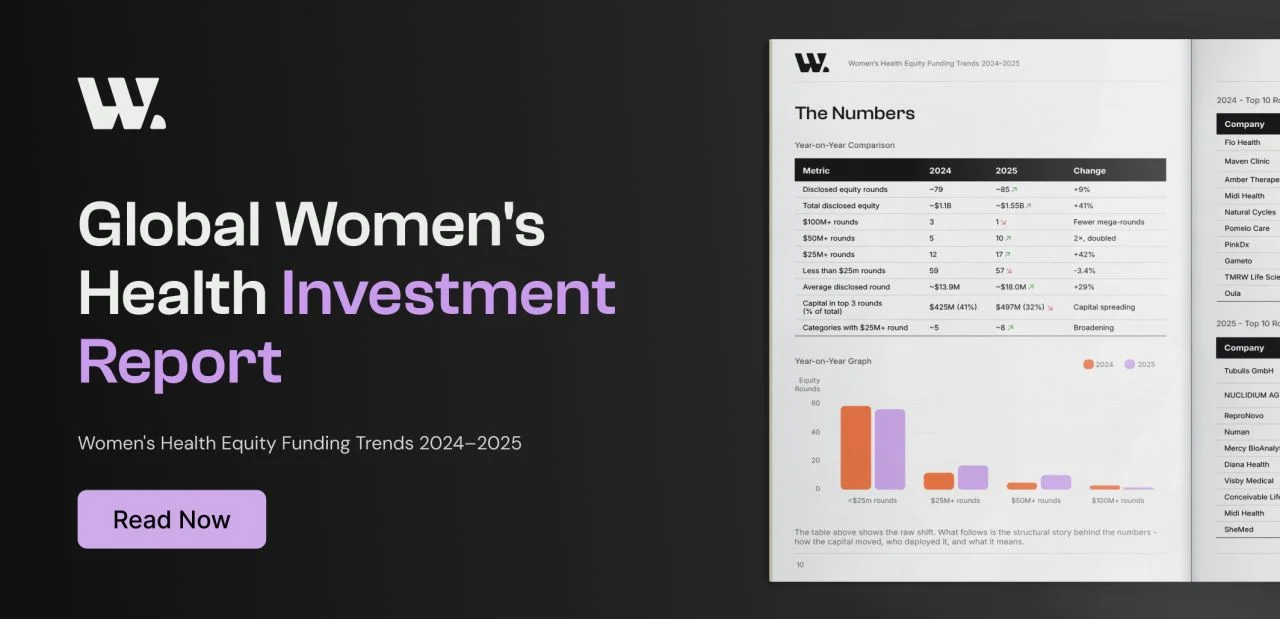
Women's health investment just hit a record high, and SheMed is part of the story.
W Group has released its first Global Women's Health Investment Report, The Road to the Era of Scale, and SheMed is featured in it. The report tracks the state of funding across the women's health sector, and the numbers tell a story worth paying attention to, whether you're building in this space, investing in it, or simply care about where women's healthcare is headed.
The headline numbers
Women's health companies raised a record $1.55 billion in disclosed equity over the past year, a 41% increase year on year. Eighty-five companies raised equity, the highest single-year count on record. Rounds of $50 million or more doubled compared to the year before.
But the most interesting finding in the report isn't the total. It's where that money went.
Capital is finally spreading
For years, women's health funding has clustered around a small number of high-profile companies and categories. This report shows that pattern starting to break down. Capital reached more companies, more categories, and more countries in the past year than at any point on record, spanning more than 15 categories and over 30 countries.
That matters because women's health has never been one market. It spans fertility, menopause, metabolic health, maternal care, mental health and more, each with different needs, different clinical pathways and different founders solving very different problems. A funding landscape that concentrates around one or two categories doesn't serve any of them well. This shift toward broader distribution is a sign the sector is starting to mature.
Why this is called the "Era of Scale"
W Group's team frames 2026 as women's health entering an "Era of Scale," a period where the sector moves beyond proving the market exists and into building durable, well-capitalised companies across the board. It's a meaningful shift in tone from years of asking whether investors would take women's health seriously to a report actively measuring how far that seriousness has come.
That said, the report is careful not to overstate where things stand. It flags a real structural risk: a bottleneck at Series A that's leaving a number of promising seed-stage companies stuck without a clear path to their next round. Closing that gap is framed as the highest-leverage move the ecosystem can make this year, and it's a fair challenge to sit with. Growth at the top of the funnel means little if companies can't get through the middle of it.
A category that didn't exist a year ago
Here's the detail SheMed is most proud of. According to the report, no dedicated women's GLP-1 company appeared anywhere in the 2024 funding data. In 2025, SheMed raised $50 million at Series A, and a new investable category came into existence in the process. The report describes GLP-1s for women arriving as an investment category "overnight."
That's a striking way to put it, and it's not an exaggeration. Twelve months ago, this category didn't exist in any investor's taxonomy. Now it's being tracked as one of the sector's defining stories for 2025.
Why this matters for SheMed
SheMed was built because women's weight loss care has historically been treated as an afterthought: generic advice, one-size-fits-all programmes, and a system that didn't account for how hormones, life stage and health history actually affect outcomes for women specifically. Raising at Series A to build that category, and seeing it recognised in a report measuring the maturity of the entire sector, is a meaningful marker, not just for SheMed, but for every founder and team working to build women's health infrastructure that's actually built for women.
The content on the SheMed blog is provided for general informational and educational purposes only. While SheMed provides professional weight loss services and strives to ensure the information shared is accurate and up to date, we make no representations or guarantees as to its accuracy, completeness, or timeliness. This content should not be taken as personal medical advice or a substitute for consultation with a qualified healthcare provider. Always speak with your doctor or licensed medical professional about your individual health or medical needs before starting any new treatment or programme. Never disregard or delay seeking professional medical advice because of something you have read on this site. SheMed is not responsible for any actions you may take based on the information provided in this blog.
Related Articles