GLP-1 Patches: Do They Really Work for Weight Loss?
Medically reviewed by Puja Vyas, Lead Clinical Pharmacist.
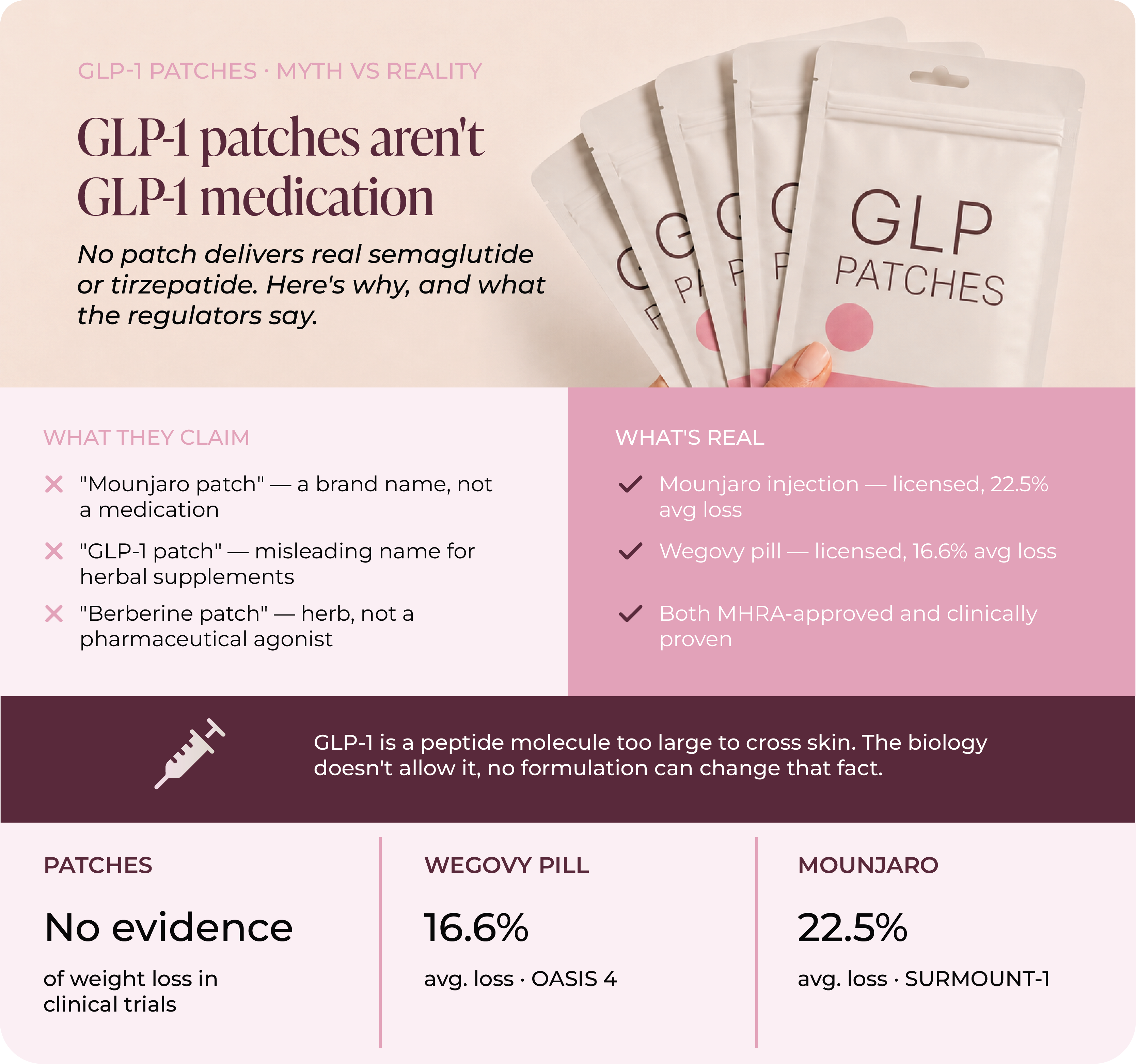
No. GLP-1 patches don’t contain any actual GLP-1, and there’s no clinical evidence they produce meaningful weight loss. They’re unregulated herbal supplement patches, not medicine.
GLP-1 patches are nothing, but some very smart marketers trying to grab the GLP-1 popularity on online search and targeting those keywords to sell random herbal patches that have absolutely no evidence of working and have nothing to do with GLP-1.
We are glad you’re here to understand the real difference. Because It’s your body we’re talking about. It’s worth understanding what GLP-1 patches actually contain, whether the science supports them, and what the clinically proven alternatives are.
Here’s what women in the UK need to know.
What Are GLP-1 Patches?
GLP-1 patches are like nicotine patches that stick to your body. They are being marketed as a needle-free version of Wegovy or Mounjaro, but they do not have any real benefits like them as they do not contain any of the active ingredients that Wegovy and Mounjaro do.
How GLP-1 Medications Actually Work
GLP-1 is a hormone your gut naturally releases after eating. It signals your brain you’re full, slows down digestion, and helps regulate blood sugar. These signals last for a few minutes. Medications like Wegovy and Mounjaro work on the same hormone, but enhance the effect of GLP-1 causing the signals to last days instead of minutes.
Now, GLP-1 is a peptide, which means it is a chain of amino acids, just like proteins. Peptides are fragile and large. It’s your stomach acid that helps break them down and get absorbed in the blood. For them to pass through your skin and make a meaningful impact is next to impossible.
This is exactly why every MHRA-approved GLP-1 medication is either an injection or a specially engineered tablet, never a patch.
If you want the full picture on how these medications work: How Wegovy Works?
What Do Weight Loss Patches Actually Contain?
The patches sold online contain things that provide the maximum return on ad spend on Google keywords, as simple as that. It can include berberine, green tea extract, chromium, B12, or garcinia cambogia. These aren’t pharmaceutical GLP-1 receptor agonists, and they don’t work through the same mechanism.
Berberine has been under a lot of limelight recently. And it does produce results, just not for weight loss. There’s some research behind it for blood sugar regulation. But again, if you look at the bioavailability, it’s less than 1% and that’s when it’s swallowed. You can imagine it with a skin patch.
There’s a reason we consider our skin as an organ. It’s an extremely effective barrier designed to keep things out, not let large molecules in.
It's the same with “Mounjaro patches”. Mounjaro’s active ingredient, tirzepatide, is only available in the UK as a licensed weekly injection. Any product calling itself a “Mounjaro patch” is using a highly searched name to sell something that has nothing to do with the real medication.
Do GLP-1 Patches Work for Weight Loss?
What the Evidence Actually Says
There hasn’t been any clinical trial to support transdermal delivery of GLP-1 medications. The ingredients found in most patches have mixed and limited evidence for weight loss even when taken orally, let alone applied to skin.
The Advertising Standards Authority has ruled against several UK weight loss patch brands since 2020 for making unsubstantiated claims like “decrease appetite” and “burn fat”. These claims count as medicinal under UK advertising rules and require evidence the products simply don’t have.
Why Are GLP-1 Patches So Popular Then?
Because the appeal makes sense. Your social media influencers have made these patches look effortless; just stick it on and forget about it. No needles, no fasting, no clinic visits. It’s like trying to charge your phone using a fridge magnet. The sticking surely works.
Show this to someone who feels anxious about injections, or who’s exhausted from years of diets that didn’t work, and you’ll have your answer for why these patches are popular.
GLP-1 Patches vs Injections vs Pills: Which Works Best?
Here’s the full picture, side by side:
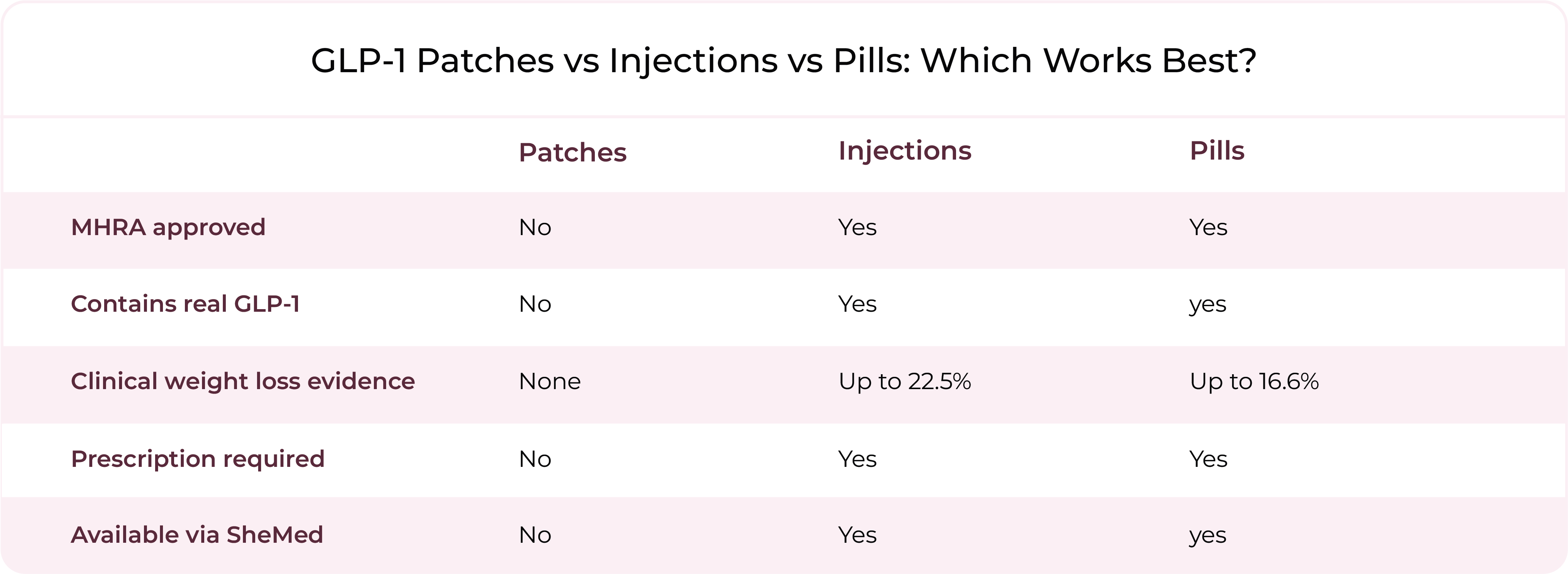
Sources: MHRA · NEJM STEP 1 Trial · SURMOUNT-1 Trial · OASIS 4 Trial
GLP-1 Injections (Wegovy, Mounjaro, Saxenda)
GLP-1 medications are MHRA approved weekly injections that produce an average weight loss of 14.9–22.5% depending on the medication and dose.
If needle anxiety is what’s pulling you toward a patch, it’s worth knowing that modern injection pens are genuinely different from what you might be picturing. Auto-injector designs with fine, near-painless needles, used once a week. Most women have told us that they are far easier to use than they had thought.
See how the pens actually work: Wegovy pen guide →
GLP-1 Pills (Oral Semaglutide / Wegovy Pill)
The Wegovy pill is currently the only oral semaglutide option available in the UK that is approved by the MHRA. The OASIS 4 trial showed that it produced up to 16.6% average weight loss with 1 in 3 participants losing over 20%. If needle phobia is real for you, this is the best alternative.
Read our full guide on the Wegovy pill vs injection.
If needles are genuinely the thing holding you back, please don’t let that turn into months on a patch that was never going to work. The Wegovy pill exists now specifically for women in your position.
It’s real medicine, properly trialled, properly licensed with clinically proven results. You deserve the thing that works, not the thing that’s easiest to order on impulse at 11pm.
Are GLP-1 Patches Safe?
Supplement patches are not particularly harmful in a way that unregulated, illegal injections are. But if you consider months of false hope and delayed treatment that could’ve been real progress as harm, then it can be a real loss.
Having said that, some patches may contain unlisted or undeclared ingredients, since they sit outside MHRA regulatory oversight as medicines. Adhesive ingredients can cause skin irritation in sensitive individuals. And because nothing is systematically monitored, no one will be able to help you if something goes wrong.
This matters even more if you have an underlying condition like PMOS, insulin resistance, or a thyroid disorder. GLP-1 medications can directly address these conditions. So the more time you spend on ineffective products like these patches, the longer those underlying issues go unaddressed.
What Actually Works for Women: Clinically Proven Weight Loss Options
Women’s bodies work differently than men’s. They go through phases in their lives that men don’t. This is why the weight loss journey for women is also a bit different.
Why Women’s Weight Loss Is Different
Women’s weight loss isn’t just about appetite, it includes dealing with hormones, the menstrual cycle, PMOS, and perimenopause in ways that generic advice rarely addresses.
PMOS causes insulin resistance, oestrogen levels start declining in your 40s, your appetite also sits at different points in your cycle. These are real physiological factors that no berberine patch is designed to touch.
GLP-1 medications, on the other hand, work directly on the hormonal and metabolic drivers behind all of this. This is why women see much better performance during these treatments.
SheMed’s Clinician-Led Approach
We, at SheMed, have a woman first approach to everything. If it doesn’t benefit women directly, we don’t do it. Which is why we only prescribe MHRA-approved medications like Wegovy, Mounjaro, and now the Wegovy pill.
All of these with a free at-home blood test before anything is prescribed, and a real clinician making your dose decisions based on your results, not a quiz.
For only £59 for your first month, blood test included. Start your journey →
Frequently Asked Questions
Are there any real GLP-1 patches available in the UK?
No. As of 2026, there are no MHRA-approved GLP-1 patches with medications such as semaglutide or tirzepatide. Products sold as “GLP-1 patches” online contain supplements, not pharmaceutical GLP-1, and are not regulated as medicines in the UK.
What do GLP-1 weight loss patches contain?
Most weight loss patches sold in the UK contain herbal or nutritional supplements such as berberine, green tea extract, chromium, or B vitamins. These are not the same as GLP-1 receptor agonists used in medications like Wegovy or Mounjaro and have no equivalent clinical evidence for significant weight loss.
Do Mounjaro patches exist?
No. Mounjaro (tirzepatide) is only available as a licensed weekly injection in the UK. Products sold as “Mounjaro patches” are not the real medication and have no regulatory approval. If you see these advertised online, treat them with caution.
Are slimming patches the same as GLP-1 patches?
No. They don’t contain any active ingredient that GLP-1 medications do. Slimming or diet patches typically contain supplement blends that are not MHRA-approved for weight loss and have no clinical evidence comparable to licensed GLP-1 medications.
What is the best alternative to GLP-1 patches for women?
The most effective clinically proven alternatives are MHRA-approved GLP-1 medications such as Wegovy or Mounjaro, or oral semaglutide (the Wegovy pill) for those who prefer not to inject. These are available through clinician-led programmes like SheMed, which offers free blood tests and personalised plans designed specifically for women.
Sources & Further Reading
1. MHRA — Medicines and Healthcare products Regulatory Agency
2. NHS — Obesity Treatment Overview
3. NHS — Weight Loss Medicines Overview
4. Wilding JPH et al. — STEP 1: Semaglutide 2.4mg for Obesity. NEJM, 2021
5. Jastreboff AM et al. — SURMOUNT-1: Tirzepatide for Obesity. NEJM, 2022
6. NICE NG246 — Weight Management Guidance
7. Diabetes UK — GLP-1 Analogues
8. British Heart Foundation — Obesity Medicines
The content on the SheMed blog is provided for general informational and educational purposes only. While SheMed provides professional weight loss services and strives to ensure the information shared is accurate and up to date, we make no representations or guarantees as to its accuracy, completeness, or timeliness. This content should not be taken as personal medical advice or a substitute for consultation with a qualified healthcare provider. Always speak with your doctor or licensed medical professional about your individual health or medical needs before starting any new treatment or programme. Never disregard or delay seeking professional medical advice because of something you have read on this site. SheMed is not responsible for any actions you may take based on the information provided in this blog.
Related Articles

