
Wegovy Pill vs Injection: Which Is Right for You in 2026?

Medically reviewed by Puja Vyas, Lead Clinical Pharmacist.
Want to lose weight but had a reaction to injections?
Introducing Wegovy – now in pill form! The Wegovy Pill is now available legally in the UK and a lot of you have been asking the right questions regarding the efficacy and safety of this pill. And we are glad you are. You deserve to know all the right answers now that the pill has hit the market.
This guide covers everything you need to know: how the two forms work differently, what the trial data actually shows, who each option suits, and what the pill’s UK status means for your decision right now.

How Do the Wegovy Pill and Injection Work Differently?
Let’s start with what doesn’t change.
Both the Wegovy pill and the Wegovy injection contain the same active ingredient: semaglutide. Both work on the GLP-1 mechanism. They signal to your brain that you’re full, slow down how quickly your stomach empties, and help regulate blood sugar. So, the weight loss mechanism is identical.
Now here’s what’s different – Absorption.
How semaglutide injection gets into your bloodstream
The injection delivers semaglutide directly into subcutaneous tissue (the fat layer just under the skin), typically in the abdomen, thigh, or upper arm. From there, it gets absorbed gradually and enters the bloodstream predictably.
• Bioavailability is approximately 89%, meaning almost all of the dose reaches the bloodstream
• A single 2.4mg weekly injection maintains consistent therapeutic levels throughout the week
• Your diet, other medications, time of injection, etc., do not affect the absorption
• The injections require refrigeration at 2–8°C (can be kept at room temperature for up to 6 weeks once in use)
If you’re a user, you’re most probably familiar with all of these facts. But here’s what changes when it comes to the pill -
How the Oral Wegovy Pill Is Absorbed & the Role of SNAC
Protein drugs are one of the hardest to deliver orally in pharmaceutical science. This is because your Stomach acid would normally destroy semaglutide before it could be absorbed.
Wegovy pill solves this with a compound called SNAC (sodium N-[8-(2-hydroxybenzoyl) amino] caprylate).
(Yes, you’re not the only one. Even doctors find it very difficult to pronounce initially. Which is why we’ll be referring to it only as SNAC.)
SNAC -
• Creates a localised increase in pH inside the stomach, which in turn protects semaglutide from acid degradation
• Temporarily increases the permeability of stomach lining cells, allowing semaglutide to reach the bloodstream before reaching the small intestine
• Enables absorption in the stomach rather than the small intestine, to avoid the aggressive enzyme breakdown there.
The result?
The bioavailability of oral pills drops to approximately 0.8–1%. Yes, that is very low compared to the injection. And this is why the maintenance dose for the pill is 25mg, while it is 2.4mg for the injection.

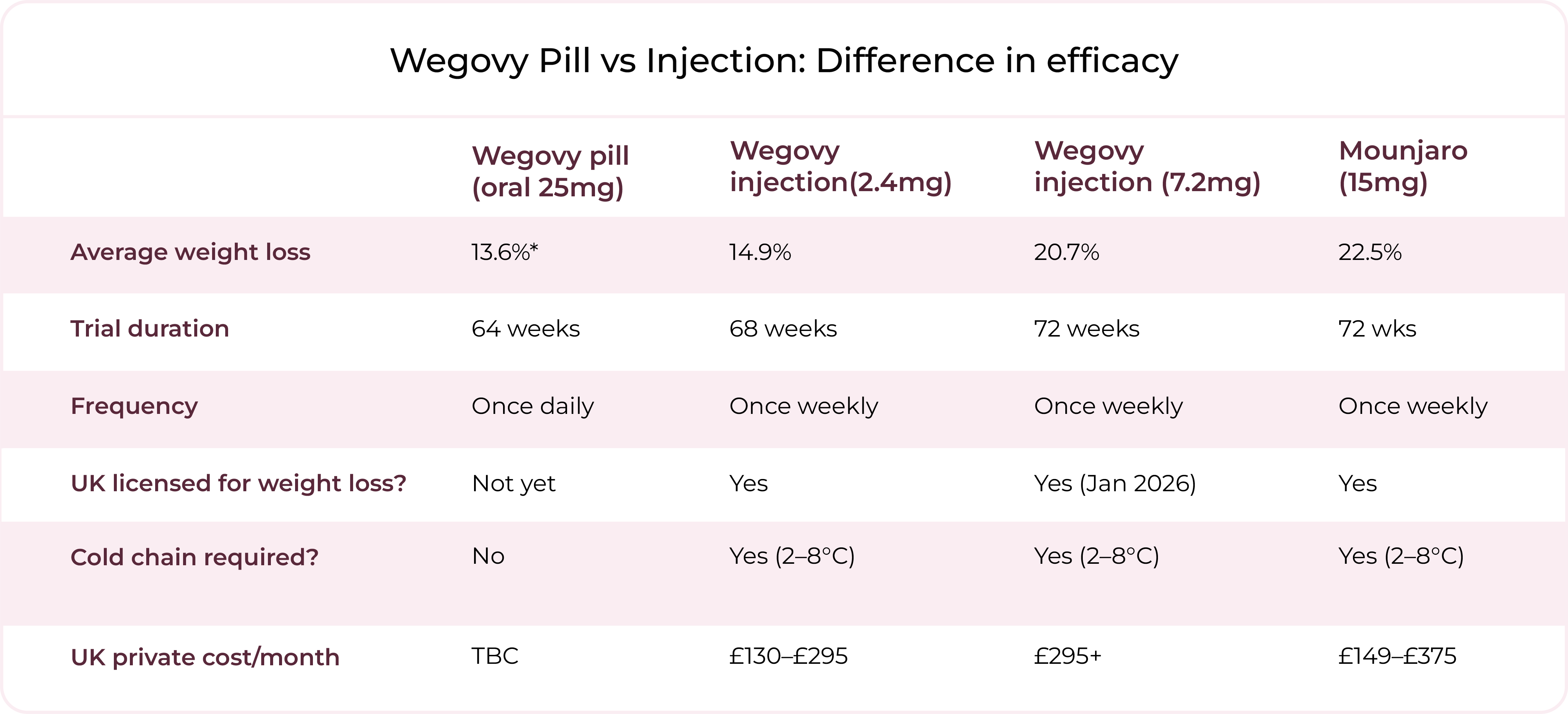
Wegovy Pill vs Injection: Difference in efficacy
Here’s what the trial data found -
Why Results Differ Between Pill and Injection
The difference, honestly, isn’t very significant. And the fact that the results are subjective means some of you may even be able to achieve higher ones. But it is important for you to know the reasons behind the difference -
• Bioavailability: 89% for the injection vs 1% for the pill. That’s a huge difference. And while the higher pill dose compensates for it, it also introduces more variability.
• Consistency: Your lifestyle, other medications, etc., won’t affect the absorption of the injection, but they will for the pill. So the results will be highly dependent on how strictly the fasting protocol is followed, gastric emptying rates, and individual stomach conditions day to day.
• Dose ceiling: The MHRA has now approved a 7.2mg dose in the UK (January 2026), which produces an average weight loss of 20.7%. This is way higher compared to the 13.6% for the pill at its highest 25mg dose.
What OASIS 4 Found Specifically for Women
The OASIS 4 trial data for women is genuinely compelling. So, for all the women and the lovely men caring for their loved ones, this section is an important one -
Convenience and Lifestyle Fit
This is where the biggest difference lies between the pill and the injection.
Daily Pill vs Weekly Injection
• The injection - One weekly injection, any time of day, with or without food. This means a low daily burden and a system that can be followed consistently.
• The pill - One tablet every single morning, on an empty stomach, with no more than 120ml of plain water, followed by a strict 30-minute fast.
We don’t think you’ll need a further explanation here.
Plus, the risk of not following this routine for the pill is high. Take it with food, or eat within 30 minutes, and your absorption drops significantly.
We know some women, for whom this fits naturally into a morning routine. But we know many others, especially those with early childcare responsibilities, demanding work starts, or just a coffee-first-thing habit, it can be a real daily challenge. Again, completely understandable.
Travel, Needle Phobia, and Storage
Now this is where the pill wins.
• No cold chain - The pill requires no refrigeration. The injection, on the other hand, must be kept at 2–8°C, though it can be stored at room temperature for up to 56 days once in use.
• Needle phobia - This can probably be the biggest win for the pill. The injection may win on the absorption front, but for some women, needle phobia is a serious one.
• Sharps disposal – The injection requires proper disposal of used pens. This isn’t a make or break condition, but yet adds a point to team pill.
• Discretion: This is a very subjective point. For some women, carrying a daily pill feels less conspicuous than carrying an injection pen and is easier to travel with. However, the injection’s weekly nature itself allows it to be discrete.
What about Side Effects? Are They Different?
Common Side Effects -
Most of the side effects seen between the pill and the injection are common, since both work on the same GLP-1 mechanism. Most are gastrointestinal and tend to cluster during dose escalation. They include -
• Nausea (the most common one across both)
• Constipation
• Diarrhoea
• Fatigue, particularly in early weeks
Unique side effects to the pill -
In OASIS 4, vomiting was notably more common with the pill than typically reported with the injection:
• Nausea: 46.6% (pill) vs 18.6% (placebo) in OASIS 4
• Vomiting: 30.9% (pill) vs 5.9% (placebo) - higher than usually seen with the needle version
• Discontinuation due to adverse events: 6.9% with the pill, similar to the injection
Fasting could be the main reason behind the higher vomiting rates. Taking medication on a truly empty stomach can trigger stronger GI responses. It may also reflect absorption dynamics that differ from subcutaneous delivery.

Now, the most important part that you were waiting for -
Cost Comparison
Wegovy Injection: Current UK Costs
Here’s what Wegovy injection costs in the UK in 2026 -
• Starter doses (0.25mg–1mg) - £130–£150/month
• 2.4mg maintenance dose - £200–£295/month
• 7.2mg dose (approved January 2026) - £295+/month
NHS access is available but highly restricted, with strict eligibility criteria and long waiting lists in most areas.
With SheMed, you can start your journey from only £59.
Should I Switch from Wegovy Injection to Pill?
If You’re Already on the Wegovy Injection
Now that it's available, you may be able to switch from injection to pill, as both contain the same active ingredient.
However, it won’t be a like-for-like dose swap. Your prescriber will need to make an individual clinical decision about your starting oral dose. The pill’s higher GI side effect rate, especially vomiting, is worth considering before deciding.
If You’re on Mounjaro
Switching from Mounjaro to oral semaglutide is not a straightforward move. Mounjaro (tirzepatide) activates two hormone receptors, GLP-1 and GIP, as compared to only GLP-1 for Wegovy. If and when you switch, you would be removing the GIP mechanism, which plays a meaningful role in Mounjaro’s stronger average outcomes.
In clinical terms, Mounjaro at 15mg produces an average of 22.5% weight loss (way more than the current trial results show by the pill). If cost is the driver, it’s worth exploring whether the Wegovy injection at 7.2mg (which narrows the gap) might be a better middle ground than the pill.
If You’re New to GLP-1s
For you’re about to begin your weight transformation programme, the pill could be an attractive first step particularly for women with needle phobia, frequent travelling and who don’t mind a fixed morning routine.
If you feel like knowing more about the Wegovy pill, we’ve written a series of articles on it. Keep reading -
Complete guide to the Wegovy Pill→
How to take the Wegovy pill →
Weight loss pills in UK→

More guides
Bruising after a GLP-1 injection: causes and when to speak to a clinician →
Wegovy pill vs injection: which is right for you? →
Using Mounjaro? Mounjaro needle size guide →
Ready to take the next step? SheMed can support your weight loss journey
Frequently Asked Questions About the Wegovy Pill vs Injection
Is the Wegovy pill less effective than the injection?
Not dramatically, but there are differences. The OASIS 4 trial showed 13.6% average weight loss over 64 weeks for the pill vs 14.9% for the 2.4mg injection over 68 weeks. With perfect adherence, the pill’s estimated result rises to 16.6%. However, the injection is now available at 7.2mg in the UK (approved January 2026), which produces 20.7% average weight loss, significantly ahead of the pill’s current data.
Can I switch from the Wegovy injection to the pill?
Yes, you can switch. The dosage, however, may not be the same. Your prescriber would need to determine an appropriate oral starting dose, and you should be prepared for a potentially higher rate of nausea and vomiting during the adjustment period.
Is the Wegovy pill available on the NHS?
Yes. The Wegovy pill is now licensed in the UK by the MHRA approval. NHS availability would require a separate NICE appraisal, a process that typically takes 6–12 months after licensing. Realistically, NHS access is unlikely before 2027 at the earliest.
Is the Wegovy pill available from SheMed?
Yes, and you can learn more information on our new Wegovy product page. It's also now available from just £59 with our limited time price drop!
Does the pill have the same side effects as the injection?
Yes, except vomiting was more commonly reported with the pill in OASIS 4 (30.9% vs typically lower rates with the injection). Nausea was also slightly higher. Both forms carry the same MHRA warning regarding the very rare risk of NAION (a serious eye condition).
Sources & Further Reading
1. Wharton S et al. — OASIS 4: Oral Semaglutide 25mg for Overweight and Obesity. NEJM, 2025
2. Wilding JPH et al. — STEP 1: Semaglutide 2.4mg for Obesity. NEJM, 2021
3. Wharton S et al. — STEP UP: Semaglutide 7.2mg. Lancet Diabetes Endocrinol, 2025
4. MHRA — Updated Guidance for Semaglutide Prescribers and Patients (GOV.UK, February 2026)
5. MHRA — GLP-1 Medicines for Weight Loss and Diabetes: What You Need to Know (GOV.UK)
6. Aroda VR et al. — SNAC as an Absorption Enhancer for Oral Semaglutide. Clinical Diabetes, 2024
7. Applied Clinical Trials — OASIS 4 Post-Hoc Analyses: Women and Menopause (March 2026)
8. NHS — Obesity Treatment Overview
9. SheMed — Wegovy Treatment Programme
10. Novo Nordisk press release — OASIS 4 results (September 2025)
11. Medino.com — Wegovy Cost Per Month UK (2026 Guide)
12. Simple Online Pharmacy — Wegovy Pill Cost in the UK: Pricing and Access
The content on the SheMed blog is provided for general informational and educational purposes only. While SheMed provides professional weight loss services and strives to ensure the information shared is accurate and up to date, we make no representations or guarantees as to its accuracy, completeness, or timeliness. This content should not be taken as personal medical advice or a substitute for consultation with a qualified healthcare provider. Always speak with your doctor or licensed medical professional about your individual health or medical needs before starting any new treatment or programme. Never disregard or delay seeking professional medical advice because of something you have read on this site. SheMed is not responsible for any actions you may take based on the information provided in this blog.
Related Articles