
PCOS and Menopause: What Changes, and What Doesn’t
Medically reviewed by Puja Vyas, Lead Clinical Pharmacist.
Before we tell you about PCOS and Menopause, it is important for you to know that PCOS has officially been renamed as PMOS. And this is not just a cosmetic change. It is one that completely changes the picture.
For decades, women were told they had ‘polycystic ovaries’ and sent away with a leaflet. But the name itself told an incomplete story. It focused only on ovarian cysts, which a 2026 study confirmed don’t cause the condition at all. In May 2026, after a 14-year global effort involving 22,000 survey responses from patients and clinicians, the condition was officially renamed in The Lancet.
But for this article, we’ll keep referring to it as PCOS since you’re more accustomed to it.
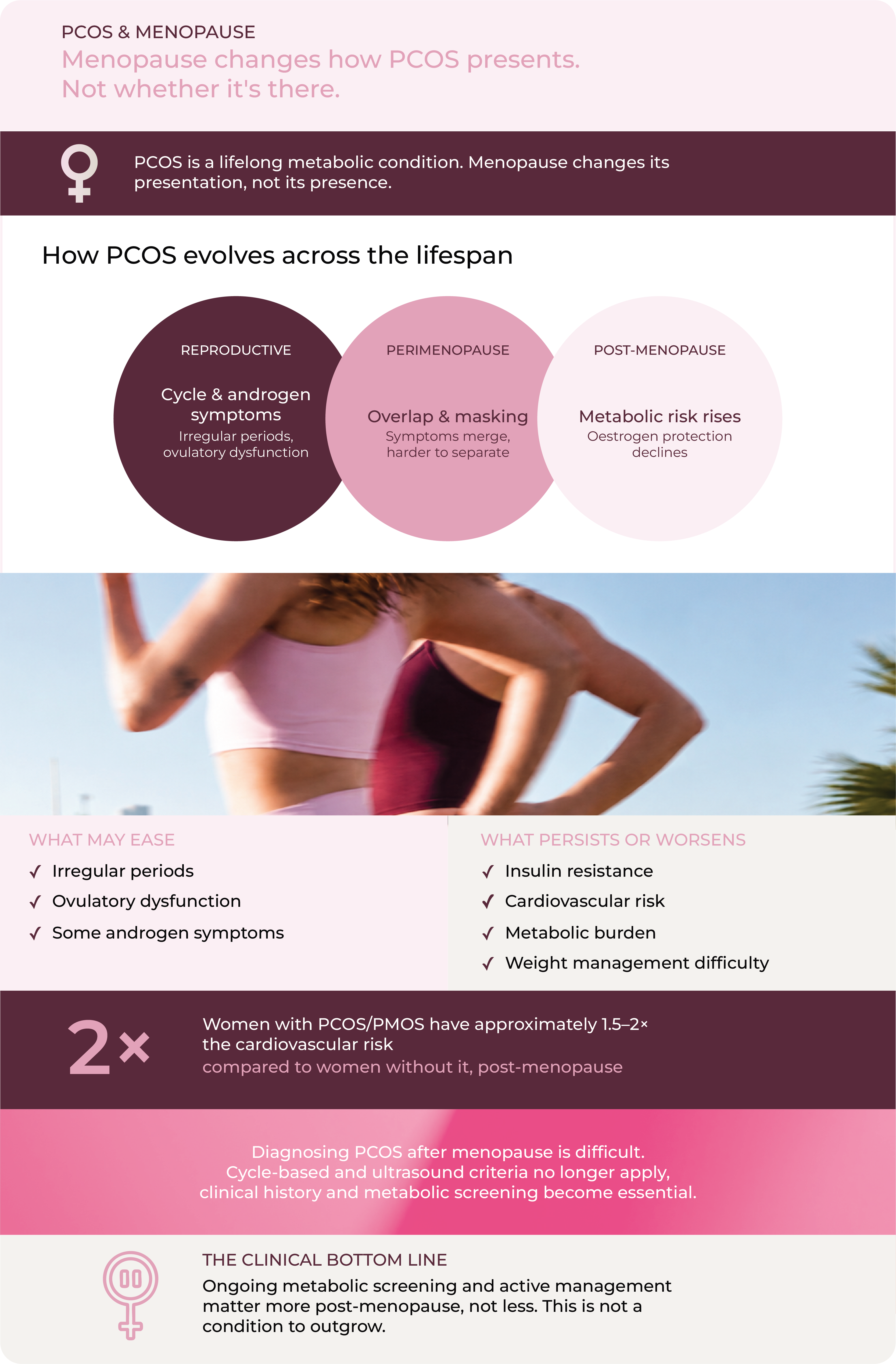
PCOS doesn’t go away at menopause. Symptoms like irregular periods, ovulatory problems, some androgen-driven symptoms, etc. do ease as ovarian activity declines during the phase. However, the underlying metabolic picture that includes insulin resistance, cardiovascular risk, weight persists, and for some women even intensifies. Menopause basically just changes how PCOS presents, not whether it’s present.
We’ve heard a lot of women say that PCOS is a ‘reproductive years’ condition that stops when periods do. But this is one of the most consequential misunderstandings in women’s healthcare and it leads to exactly the kind of dismissed, under-monitored care that women with PCOS have been navigating their whole lives.
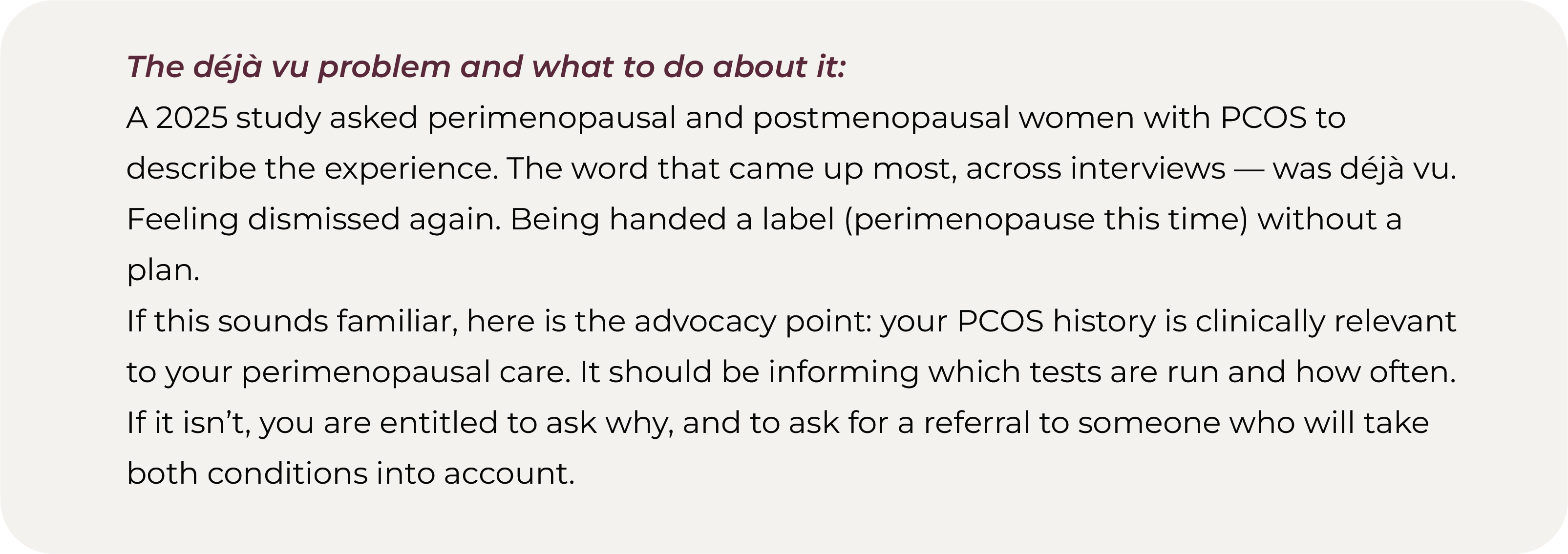
A 2025 study published in Frontiers in Global Women’s Health interviewed 29 perimenopausal and postmenopausal women with PCOS. One theme kept appearing again and again - “Déjà vu.” Women described feeling dismissed and without a plan all over again, just as they had been at their original PCOS diagnosis decades earlier.
You deserve better than that. This article explains what the evidence actually says about PCOS through and after menopause.
Does PCOS Go Away After Menopause?
No. Never completely. What changes is just which features are most prominent.
Why Some Symptoms Ease
The reproductive features of PCOS are driven partly by active ovarian follicles and the hormonal cycles around ovulation. When periods stop after menopause, several things improve -
- Irregular or absent periods are no longer a concern
- Fertility-related aspects of the condition become irrelevant for most women
- Some androgen-driven symptoms like acne, in particular can ease as androgen levels reduce with age
- For some women the food noise and cravings they experienced earlier tend to improve
This is where most women feel PCOS has been resolved. Unfortunately, it hasn’t. It’s just that the features which were most visible day-to-day have changed.
Why the Metabolic Picture Often Doesn’t Improve after Menopause
Oestrogen supports insulin sensitivity, promotes healthier fat distribution, and plays a role in maintaining lipid profiles and vascular health. During menopause, oestrogen levels decline and so do these protective effects. This happens to all women, but more sharply to women with PCOS who already had compromised insulin sensitivity going in.
Here’s the evidence:
- 70-80% of women with PCOS experience insulin resistance and it tends to worsen after menopause as oestrogen’s insulin-sensitising effects fade
- Visceral fat accumulation, already higher in PCOS due to androgen excess and insulin resistance, intensifies post-menopause as declining oestrogen shifts fat storage toward the abdomen
- Women with PCOS/PMOS who were borderline insulin resistant during reproductive years may develop overt type 2 diabetes post-menopause
- Women with PCOS/PMOS have approximately 1.5–2 times the cardiovascular risk of women without the condition. This risk persists and may even increase post-menopause
How Does PCOS Affect the Menopause Transition?
The Timing Dilemma
Some research indicates that the menopause timeline can be slightly different for women with PCOS as compared with women without. However, the evidence here is mixed.
Women with PCOS/PMOS typically have higher ovarian reserve (more follicles), as reflected in elevated AMH levels. This higher reserve may naturally cause a later menopause according to some studies.
However, a systematic review from the International Menopause Society found no clear difference in average menopause age between women with and without PCOS.
The Symptom Overlap Problem
Perimenopause and PCOS share a striking number of symptoms, and these makes having PCOS during midlife very confusing.
- Irregular periods and cycle changes
- Mood changes, anxiety, and low mood
- Weight gain, particularly around the abdomen
- Sleep disruption and fatigue
- Skin and hair changes
When women start seeing these symptoms in their 40s, most clinicians attribute them to perimenopause, when in reality it may be PCOS/PMOS worsening, the menopause transition, or both simultaneously.
The overlap is real, and it requires a clinician who understands both conditions rather than reaching for the nearest explanation.
Can You Be Diagnosed With PCOS After Menopause?
Technically, yes, but practically, it’s much harder, and here’s why.
The standard diagnostic criteria for PCOS (PMOS to be more accurate) includes 2 or 3 features:
- Irregular cycles
- Androgen excess (clinical or biochemical)
- Polycystic ovarian morphology on ultrasound or elevated AMH.
The first one, cycle irregularity, anyways becomes irrelevant after menopause. The reference ranges for AMH and ovarian morphology are different in postmenopausal women. This means that two of the three standard criteria become difficult or impossible to apply reliably.
What clinicians rely on instead in postmenopausal women is clinical history, a prior PCOS diagnosis, a history of irregular periods or androgen symptoms during reproductive years. They combine it with ongoing metabolic features like insulin resistance, dyslipidaemia, and body composition. Hirsutism (excess facial/body hair), notably, tends to persist post-menopause in women with PCOS/PMOS and is one of the more consistent ongoing clinical signs.
Read more about: PCOS/PMOS: symptoms, causes and diagnosis →
Managing PCOS/PMOS Symptoms Through and After Menopause
Weight and Insulin Resistance
Insulin resistance is the stubborn one that doesn’t go away after menopause. Without oestrogen’s protective effects, it actually becomes harder to manage. Things that helped during reproductive years including low-GI eating, resistance training, adequate sleep, reducing visceral fat now play a more important role post-menopause.
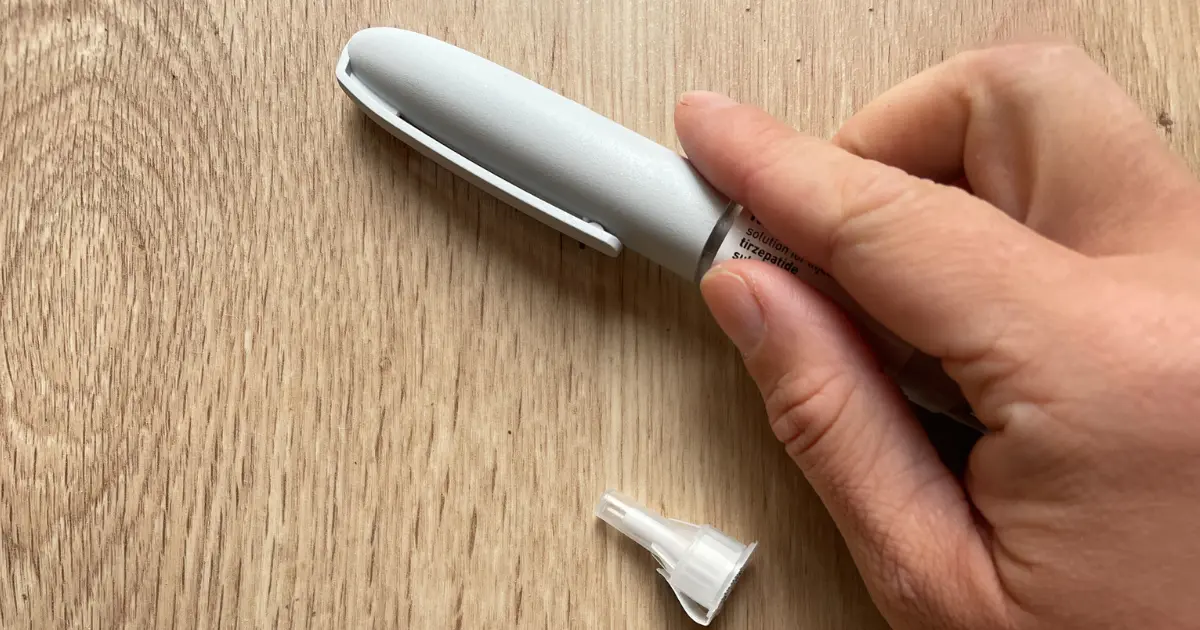
But when you’re fighting biology, and not just will power, things can get difficult. This is where GLP-1 medications can help. They can work along with your biology to directly address insulin sensitivity, reduce visceral fat and lower cardiovascular risk.
For eligible women, GLP-1 medications remain an option post-menopause. The eligibility criteria (BMI 30+, or BMI 27+ with a comorbidity) don’t change at menopause. And
Know more about: PCOS and weight loss: why it’s harder and what actually helps →
Mounjaro and PCOS: what the evidence says →
Cardiovascular and Metabolic Screening
Conditions like hypertension, dyslipidaemia, insulin resistance progression toward type 2 diabetes, and cardiovascular disease usually tend to accelerate post meno-pause. And these are all conditions that PCOS predisposes to.
This is why they need active monitoring, and not passive watchfulness -
- Annual blood pressure check
- Fasting glucose and HbA1c at least every 1–2 years
- Lipid profile including HDL, LDL, and triglycerides
- Weight and waist circumference monitoring
- Thyroid function, particularly relevant given the higher thyroid disorder prevalence in women with PCOS/PMOS
If you have PCOS and haven’t had a metabolic screen recently, this is a sign and our request to you to get one done at the earliest.
HRT and PCOS
HRT or Hormone Replacement Therapy is medication that replaces the hormones, mainly oestrogen and progesterone, that your body stops producing during menopause. It's most commonly prescribed to manage menopausal symptoms like hot flushes, sleep disruption, and mood changes.
The good news is that HRT is not off the table if you have PCOS.
Here’s what you need to know before you have that conversation with your GP or clinician:
Which type of HRT tends to suit women with PCOS better - Transdermal oestrogen which is absorbed through the skin via a patch, gel, or spray is generally preferred over an oral oestrogen tablet for women with metabolic risk factors. The reason is simple: a tablet has to pass through your liver first, which can affect cholesterol levels and clotting risk. Skin-absorbed oestrogen bypasses that.
The progesterone question. If you still have a womb, HRT needs to include progesterone to protect the womb lining. If you also take GLP-1 medications like Wegovy or Mounjaro, you must talk to your prescriber regarding this. Oral progestogen absorption can be affected by GLP-1s, so a non-oral form (like a patch or the Mirena coil) may be more suitable.
What HRT won't do. It won't resolve the insulin resistance or metabolic features of PCOS. But it can improve some of the metabolic changes that come specifically from oestrogen decline.
HRT decisions need a proper clinical conversation that takes your full history, current symptoms, and cardiovascular risk into account.
When should you Speak to a Clinician
- Periods becoming more irregular in a way that feels different from your usual PCOS/PMOS pattern
- New or worsening weight gain, particularly visceral/abdominal
- Significant mood changes, anxiety, or sleep disruption that have changed recently
- Hot flushes, vaginal dryness, or other classic menopausal symptoms
- You haven’t had a metabolic blood screen (glucose, HbA1c, lipids, blood pressure) in the last 12–18 months
- You’re wondering about HRT and want to understand your individual options
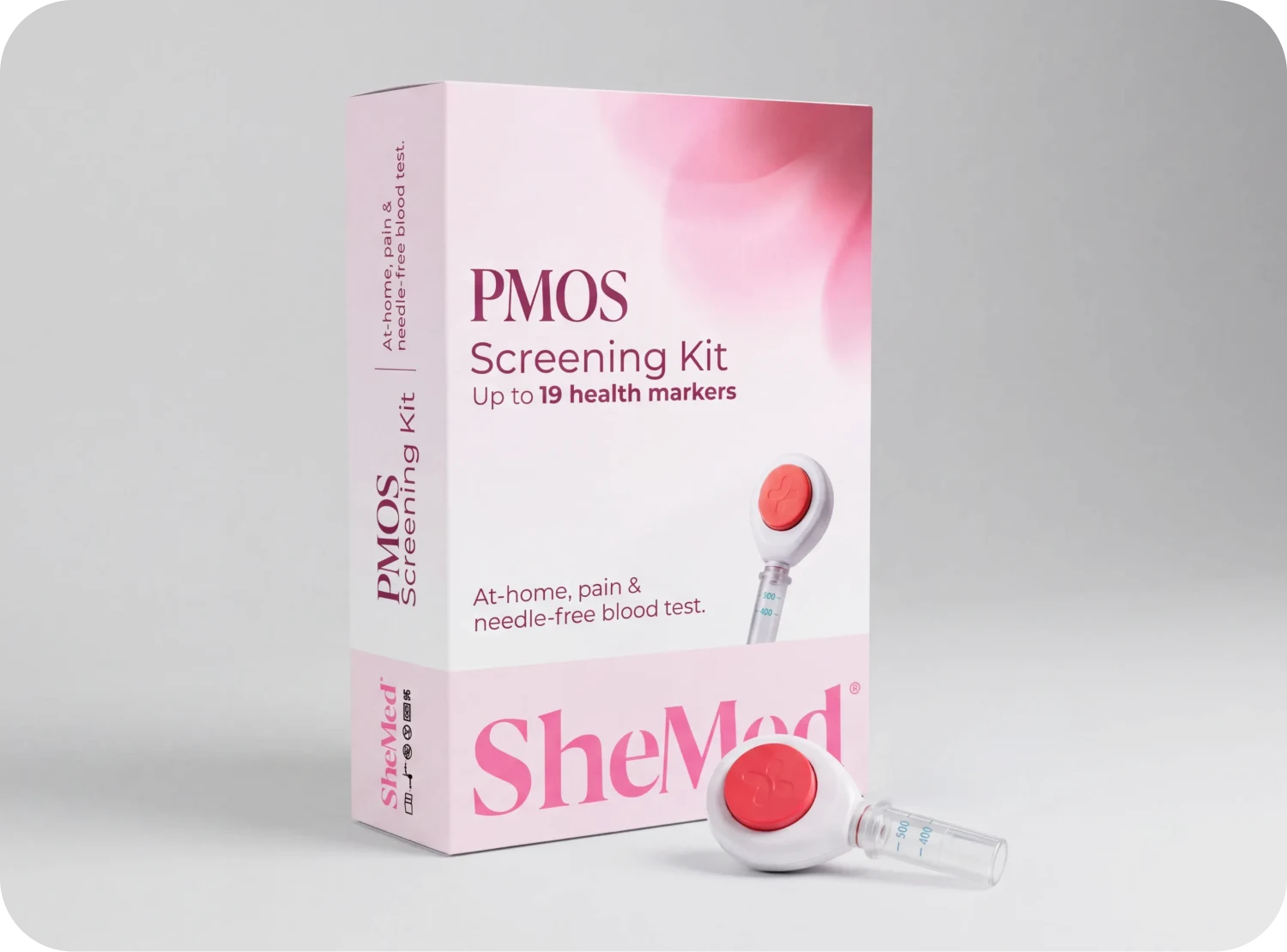
Think you might have PCOS (now PMOS)? Screen 19 health markers at home, reviewed by a clinician.
PCOS/PMOS touches almost every part of a woman's health, from how easily you lose weight, to what's happening with your hair, to which medications might actually help, to what changes when your hormones shift in midlife.
We've written a dedicated guide on each of these so you can go as deep as you need to on the parts that matter most to you right now.
- PCOS and weight loss: why it's harder and what actually helps →
- PCOS and hair loss: causes and treatment options →
- PCOS (PMOS): Symptoms, Causes and Treatment Explained →
- Mounjaro and PCOS: what the evidence says →
- PCOS Diagnosis: Blood Tests, Criteria and How to Know If You Have It→
- PCOS and Insulin Resistance: What's the Connection, and What Helps?→
- GLP-1 Medications for PCOS: How They Help with Insulin Resistance →
- PCOS Diet: What to Eat, What to Limit, and What Actually Helps →
- PCOS, Periods and Pelvic Pain: What's Normal and What Isn't
- What Is PCOS (PMOS)? A Clear Explanation of Symptoms, Causes and Diagnosis→
- PCOS Belly Fat and Bloating: Why It Happens and What Actually Helps→
Frequently Asked Questions
Does PCOS go away after menopause?
No. The reproductive features including irregular periods, ovulatory dysfunction, resolve because periods stop, not because the condition has resolved. But insulin resistance, cardiovascular risk, and the metabolic dimensions of PCOS can persist.
Does PCOS cause early menopause?
The evidence here is mixed. Women with PCOS/PMOS tend to have higher ovarian reserve (more follicles), which some studies associate with later, not earlier, menopause. A systematic review found no clear difference in average menopause age. There is no strong, consistent evidence that PCOS/PMOS causes early menopause, and we’re not going to state otherwise.
Can you be diagnosed with PCOS after menopause?
Yes, but it’s difficult using standard criteria, because two of the three diagnostic criteria (irregular cycles and ovarian morphology/AMH) are harder to apply post-menopause. Clinicians typically rely on clinical history that includes a prior diagnosis or a history of irregular periods and androgen symptoms during reproductive years. They also look at ongoing metabolic features like insulin resistance, hirsutism, and dyslipidaemia.
Does PCOS get better or worse after menopause?
Both. Reproductive symptoms improve. Metabolic risk often worsens, as oestrogen’s protective effects on insulin sensitivity, fat distribution, and vascular health are lost. Women with PCOS have approximately 1.5–2 times the cardiovascular risk of women without the condition, a risk that persists and may intensify post-menopause.
Can you take HRT if you have PCOS?
Yes, HRT is not contraindicated in women with PCOS/PMOS. Transdermal oestrogen is generally preferred for women with metabolic risk factors. If you haven’t had a hysterectomy, progesterone is required to protect the womb lining. HRT decisions need an individual clinical assessment. We advise you to consult a clinician rather than making this decision based on an article.
Sources & Further Reading
1. International Menopause Society — PCOS in Peri- and Postmenopausal Women (2023)
3. PMC — PCOS Transition at Menopause (PMC8189337)
4. NHS — Polycystic Ovary Syndrome (PCOS)
6. Teede HJ et al. — Polyendocrine Metabolic Ovarian Syndrome, the new name for PCOS. The Lancet. 2026.
7. Teede H, Deeks A, Moran L. — PCOS: A Complex Condition. BMC Medicine, 2010. PMID: 20591140
8. Cleveland Clinic — Polycystic Ovary Syndrome (PCOS)
9. WHO — Polycystic Ovary Syndrome Fact Sheet
The content on the SheMed blog is provided for general informational and educational purposes only. While SheMed provides professional weight loss services and strives to ensure the information shared is accurate and up to date, we make no representations or guarantees as to its accuracy, completeness, or timeliness. This content should not be taken as personal medical advice or a substitute for consultation with a qualified healthcare provider. Always speak with your doctor or licensed medical professional about your individual health or medical needs before starting any new treatment or programme. Never disregard or delay seeking professional medical advice because of something you have read on this site. SheMed is not responsible for any actions you may take based on the information provided in this blog.
Related Articles