PCOS Diagnosis: Blood Tests, Criteria and How to Know If You Have It
Medically reviewed by Puja Vyas, Lead Clinical Pharmacist.
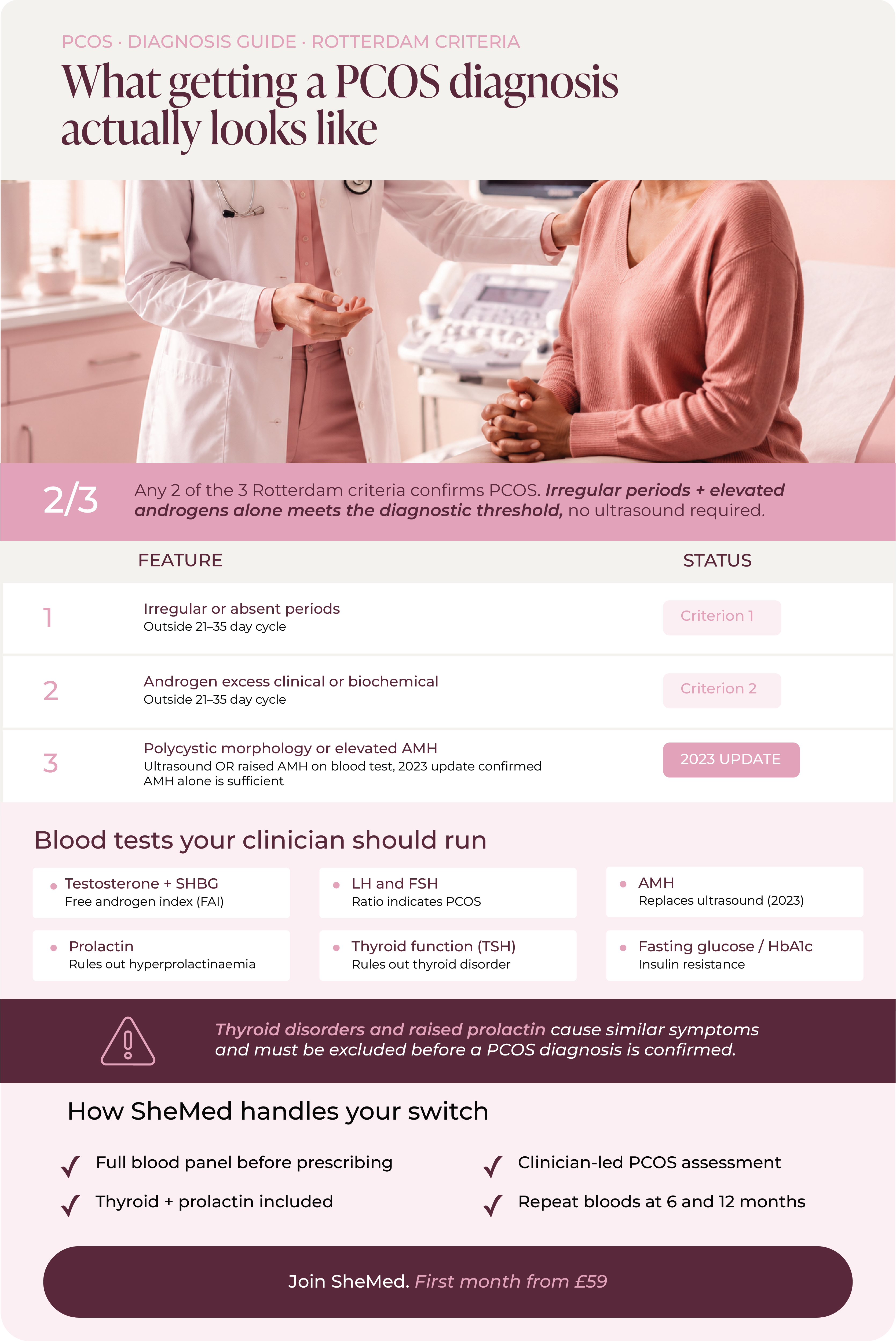
PCOS is diagnosed using a framework called the Rotterdam criteria. You need to meet at least 2 of the following 3 features: irregular or absent periods, signs of elevated androgens (either visible symptoms or blood test results), and polycystic ovarian morphology on ultrasound or an elevated AMH blood test.
You do not always need an ultrasound, and you don’t necessarily have to meet all three criteria. Up to 70% of women with PCOS remain undiagnosed, and many who do get a diagnosis end up spending years pursuing it.
In this article, we’ll explain what the three criteria mean, which blood tests matter, and what to do if you are struggling to get taken seriously.
Side note: PCOS is now also referred to clinically as PMOS (polyendocrine metabolic ovarian syndrome), following a May 2026 Lancet consensus rename. This article uses PCOS throughout as the working term.
How to Know If You Have Polycystic Ovaries
You cannot know for sure without a proper clinical assessment. However, there is a pattern of symptoms that usually asks for an investigation. It includes -
- Irregular, infrequent, or absent periods, often cycles longer than 35 days or fewer than 8 per year
- Persistent acne, particularly along the jaw, chin, and lower face
- Excess hair on the face, chest, or abdomen (also called as hirsutism)
- Thinning scalp hair, particularly at the crown and central parting
- Difficulty losing weight despite consistent effort
- Pelvic discomfort or a sense of pressure in the lower abdomen
None of these symptoms alone confirms PCOS. Each one can have other causes. It’s the pattern that matters, especially if the symptoms have been present since your teens or early twenties when PCOS most commonly first presents.
Feel like reading more about these symptoms? Here’s a detailed article for you: PCOS/PMOS: symptoms, causes and treatment →
PCOS Diagnostic Criteria: The Rotterdam Framework
The Rotterdam criteria is an internationally agreed framework established by a consensus in 2003 and updated most recently in the 2023 International Evidence-Based PCOS Guidelines. These are the criteria used by NHS clinicians in the UK.
The 3 Rotterdam Criteria
Criterion 1: Irregular or Absent Ovulation
Cycles that are consistently longer than 35 days, fewer than 8 periods per year, or periods that have stopped altogether form a part of criterion (yup, that’s the singular word for criteria) one. It’s called oligo-ovulation or anovulation in clinical terms. One or two late periods do not qualify here. It is the persistent pattern over time that matters.
Criterion 2: Androgen Excess (Hyperandrogenism)
Clinical (visible signs) or biochemical (shown on blood tests), or both are included in this criterion. Hirsutism (we explained this above), persistent acne particularly on the jaw and chin, and androgenic hair loss on the scalp are the clinical signs. Biochemical signs include elevated total testosterone, elevated free androgen index (FAI), or low SHBG on blood testing (your clinician can guide you better on what these mean). Even if you don’t have any visible symptoms, if the blood test shows these, it’s enough to qualify.
Criterion 3: Polycystic Ovarian Morphology (or Elevated AMH)
Earlier, this meant a pelvic ultrasound showing 20 or more small follicles per ovary, or an ovarian volume greater than 10cm³. The 2023 guideline updated it saying that an elevated AMH (anti-Müllerian hormone) on a blood test is now accepted as an alternative to ultrasound for assessing this criterion in adults.
This update was an important one. AMH is more convenient, less invasive, and can be measured at any point in the cycle. Having said that, AMH results are not universal. They need to be interpreted using the context of your age, whether you are on contraception pills (which suppresses AMH), and the specific laboratory’s reference range.
Again, AMH along does not confirm PCOS. It is just one of the three Rotterdam criteria.
The 2 of 3 Rule
You need at least 2 of the above 3 criteria validated to confirm PCOS. This means:
- Irregular periods + androgen excess = PCOS diagnosis (ultrasound or AMH not required)
- Irregular periods + polycystic ovarian morphology/elevated AMH = PCOS diagnosis
- Androgen excess + polycystic ovarian morphology/elevated AMH = PCOS diagnosis
Irrespective of how much clear a single criterion is, if you don’t have at least two, you don’t have PCOS. And this is very important for you to know and remember.
Some of you are told they have "polycystic ovaries" after an ultrasound but not PCOS. Visible follicles on ultrasound alone, without the other criteria, does not constitute a PCOS diagnosis. Similarly, having irregular periods alone does not mean PCOS. It could very easily be a thyroid issue, stress, or another cause entirely.
Blood Tests Used in PCOS Diagnosis
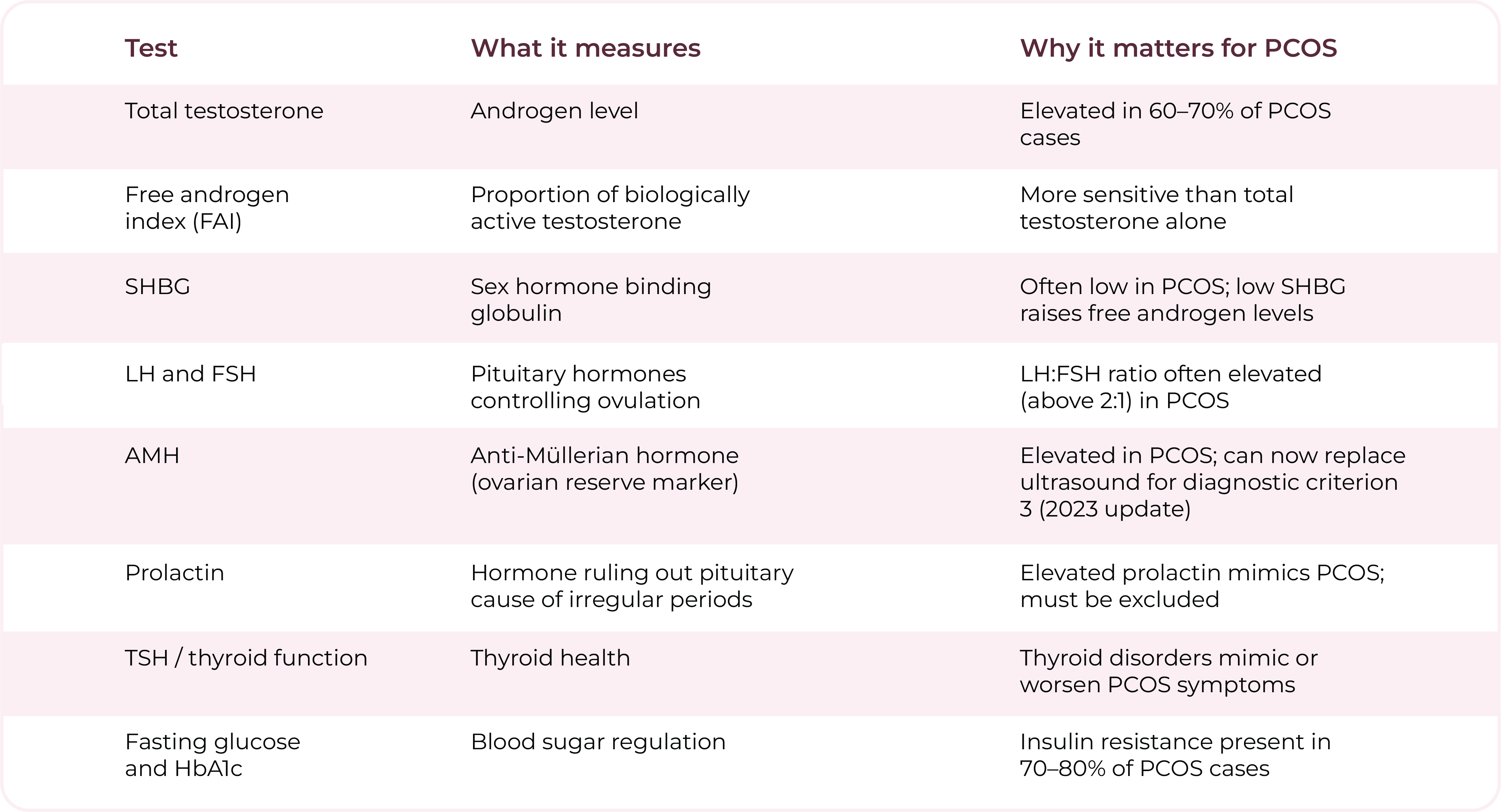
A proper blood test benefits you in two very important ways: it builds evidence for the diagnosis, and it rules out other conditions that cause similar symptoms. Here’s what you need to ask for -
When Should Blood Tests Be Done?
Hormone tests (testosterone, LH, FSH, SHBG) should ideally be done on days 2 to 5 of your menstrual cycle, when they are most representative. In case of infrequent or absent periods, you can take blood at any time. AMH is stable throughout the cycle, so it can be measured on any day. You will need to fast for at least 8 hours for fasting glucose. Fasting glucose requires fasting for at least 8 hours beforehand.
Why Thyroid and Prolactin Tests Matter
We know that you would have asked this after seeing these names in the table above. The thing is thyroid disorders and elevated prolactin are the two most common conditions that mimic PCOS symptoms, particularly irregular periods and androgen-related symptoms. Hence, both need to be excluded before confirming a PCOS diagnosis.
These are not optional tThese are not optional tests. We recommend them because treating symptoms without a proper investigation is unreliable. The treatment for hypothyroidism or hyperprolactinaemia is entirely different from the treatment for PCOS.

Does PCOS Diagnosis Always Require an Ultrasound?
No, and the NHS has clearly stated this. If you already meet 2 of the 3 Rotterdam criteria through cycle history and blood tests, an ultrasound scan is not required to confirm PCOS.
An ultrasound is recommended in two situations: when the diagnosis is uncertain after blood tests alone. For example, when only one criterion is clearly met, or when a clinician wants a more complete picture for treatment planning. An ultrasound also helps when there is a concern about other conditions affecting the ovaries or uterus.
Here’s a bit of geeky stuff if you’re interested -
What an Ovarian Ultrasound Looks For
A pelvic ultrasound for PCOS looks for the number of small follicles (typically 2 to 9mm) per ovary and overall ovarian volume. 20 or more follicles per ovary, or an ovarian volume greater than 10cm³ is the current diagnostic. A transvaginal ultrasound can give you the most accurate picture, though transabdominal can be used as an alternative.
Other Conditions with similar symptoms as PCOS
- Thyroid disorders: both hypothyroidism and hyperthyroidism can disrupt the menstrual cycle and produce symptoms that overlap with PCOS.
- Hyperprolactinaemia: elevated prolactin from a pituitary adenoma can stop periods and cause symptoms similar to PCOS.
- Congenital adrenal hyperplasia (CAH): a genetic condition causing elevated androgens from the adrenal glands rather than the ovaries.
- Cushing’s syndrome: rare but causes cortisol excess and overlapping symptoms.
- Androgen-secreting tumours: if testosterone levels are very high (typically above 5 nmol/L). It is very very rare, but yet important to exclude using imaging.
Here’s What to Do If You Feel You Have PCOS
At Your GP Appointment
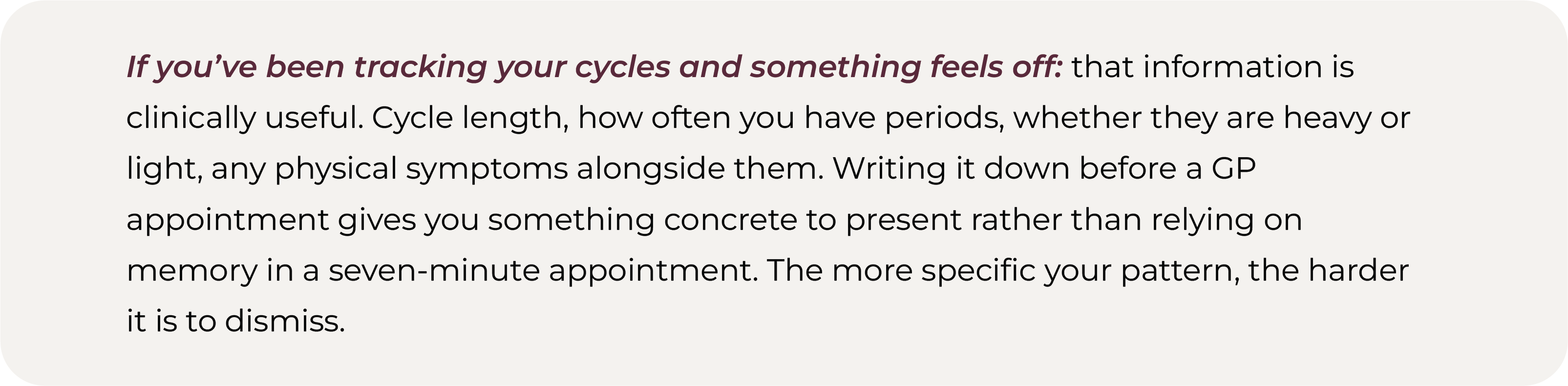
Note your cycle history for the last 3-6 months including the frequency of periods, how long each cycle lasts, whether periods are heavy or light, and if you faced any physical symptoms like an acne pattern, hair changes, or weight changes. This will give your GP specific information to work with, which in turn will make your account much harder to dismiss.
Ask specifically for a referral for blood tests covering LH, FSH, testosterone, SHBG, AMH, prolactin, thyroid function, and fasting glucose. You can ask what is being tested, and if you feel something is irrelevant, you can very much request to exclude it.
If You Have Been Dismissed
We’ve heard many cases of women with PCOS being dismissed, misdiagnosed, or told their symptoms are stress or lifestyle-related. If you’re one of them, you can request a second opinion within the NHS, ask for a referral to a gynaecologist or endocrinologist with a PCOS interest, or seek an assessment privately.
Here’s another related article: PCOS and insulin resistance: what’s the connection →
PCOS/PMOS touches almost every part of a woman's health, from how easily you lose weight, to what's happening with your hair, to which medications might actually help, to what changes when your hormones shift in midlife.
We've written a dedicated guide on each of these so you can go as deep as you need to on the parts that matter most to you right now.
- PCOS and weight loss: why it's harder and what actually helps →
- PCOS and hair loss: causes and treatment options →
- PCOS (PMOS): Symptoms, Causes and Treatment Explained →
- Mounjaro and PCOS: what the evidence says →
- GLP-1 Medications for PCOS: How They Help with Insulin Resistance →
- PCOS Diet: What to Eat, What to Limit, and What Actually Helps →
- PCOS, Periods and Pelvic Pain: What's Normal and What Isn't
- What Is PCOS (PMOS)? A Clear Explanation of Symptoms, Causes and Diagnosis→
- PCOS Belly Fat and Bloating: Why It Happens and What Actually Helps→
Think you might have PCOS (now PMOS)? Screen 19 health markers at home, reviewed by a clinician.
Frequently Asked Questions
How do you know if you have polycystic ovaries?
A pelvic ultrasound showing 20 or more small follicles per ovary or an ovarian volume above 10cm³, or an elevated AMH blood test can confirm polycystic ovarian morphology. However, you need to meet at least 2 of the 3 Rotterdam criteria to confirm PCOS, and polycystic ovarian morphology is only one of them.
What is the blood test for PCOS diagnosis?
There is no single diagnostic blood test for PCOS. Diagnosis requires meeting 2 of 3 Rotterdam criteria, with blood tests used to assess androgen excess (testosterone, FAI, SHBG) and to rule out other conditions (prolactin, thyroid function, 17-OH progesterone if needed). AMH testing can support the third criterion as an alternative to ultrasound. Metabolic tests (fasting glucose, HbA1c) are also recommended given the high prevalence of insulin resistance in PCOS.
How to know if you have PCOS without a doctor?
You cannot confirm a PCOS diagnosis without clinical assessment and blood tests. However, persistently irregular cycles (more than 35 days between periods, or fewer than 8 periods per year) alongside persistent jawline acne, excess facial or body hair, or scalp thinning, are strong indications. If this sounds like you, you should go for a GP assessment, followed by blood tests.
Does PCOS diagnosis always require an ultrasound?
No. NHS guidance states that if 2 of the 3 Rotterdam criteria are clearly met through clinical history and blood tests alone, an ultrasound is not required to confirm the diagnosis. It is most useful when the diagnosis is uncertain, when only one criterion is clearly met, or when additional information is needed for treatment planning.
Can you have PCOS with regular periods?
Yes. Around 20% of PCOS cases are ovulatory PCOS, meaning regular periods occur but there’s also androgen excess and polycystic ovarian morphology or elevated AMH (other 2 Rotterdam criteria). Women with this pattern often have milder reproductive symptoms but can still have significant metabolic features including insulin resistance.
How long does PCOS diagnosis take in the UK?
It varies. Blood tests requested by a GP are typically turned around within 1 to 2 weeks. An ultrasound referral through the NHS may take several weeks to months depending on local waiting times. Many women report diagnosis taking considerably longer because of multiple GP appointments, referrals, and the need to advocate persistently. Private assessment typically shortens this timeline significantly.
Sources and Further Reading
2. NICE CKS – Polycystic Ovary Syndrome: Investigations and Diagnosis
3. 2023 International Evidence-Based PCOS Guideline Summary (Monash University)
4. PMC – Utility of Serum AMH as Part of PCOS Diagnosis (PMC11257749)
5. Teede HJ et al. – Polyendocrine Metabolic Ovarian Syndrome, the new name for PCOS. The Lancet. 2026.
6. BMC Medicine – PCOS: A Complex Condition. Teede, Deeks, Moran (2010). PMID: 20591140
7. WHO – Polycystic Ovary Syndrome Fact Sheet
The content on the SheMed blog is provided for general informational and educational purposes only. While SheMed provides professional weight loss services and strives to ensure the information shared is accurate and up to date, we make no representations or guarantees as to its accuracy, completeness, or timeliness. This content should not be taken as personal medical advice or a substitute for consultation with a qualified healthcare provider. Always speak with your doctor or licensed medical professional about your individual health or medical needs before starting any new treatment or programme. Never disregard or delay seeking professional medical advice because of something you have read on this site. SheMed is not responsible for any actions you may take based on the information provided in this blog.
Related Articles