
Switching from Mounjaro to Wegovy: Dosage, Reviews & What Really Happens
.png)
Medically reviewed by Puja Vyas, Lead Clinical Pharmacist.
Looks like you’ve either suffered the supply issues of Mounjaro in the past and want to avoid it, or (more probably) started Mounjaro, but couldn’t handle the side effects and are thinking that Wegovy may be a better option.
Whatever it is, we’ll cover the dosage mechanics, a realistic week-by-week timeline, what patients say in both directions of switching, and when to reach out to your provider during the transition.
We’ll also address the elephant in the room: the SURMOUNT-5 trial, published in the New England Journal of Medicine in May 2025, which for the first time compared Mounjaro and Wegovy head-to-head in the same patients. (This may influence your decision, if not made already, heavily)

What Dose Do You Start on When Switching from Mounjaro to Wegovy?
There is no officially published dose conversion chart between Mounjaro and Wegovy. The two medications work through different mechanisms, measure doses in different ways, and have completely different dose ranges. The milligram numbers do not correspond to each other.
Your initial Wegovy dose is dependent on your current Mounjaro dose, how long you’ve been on it, how well you’ve tolerated it, and your overall health picture.
Will You Need to Restart from the Lowest Wegovy Dose?
Not the lowest, but you will start lower than you might expect. Here’s what the initial dose may look like:
- If you’re on Mounjaro 2.5mg–5mg: Wegovy starting dose is typically 0.25mg–0.5mg, which is Wegovy’s introductory range.
- If you’re on Mounjaro 7.5mg–10mg: You may start Wegovy dose at 0.5mg–1mg, which is, in a way, equivalent to mid-range Mounjaro experience.
- If you’re on Mounjaro 12.5mg–15mg: Wegovy starting dose will be 1.7mg (15mg). However, it may vary for some people based on their assessment.
The important thing to know here is: starting lower is not a step backwards. It’s how your prescriber protects you from unnecessary side effects while your body adjusts to Wegovy’s GLP-1-only mechanism, which works differently to Mounjaro’s dual GLP-1/GIP action.
Over 16–20 weeks, you’ll titrate up towards your maintenance dose.
Keep your documents ready
When you start with a new provider, having your treatment history to hand makes everything easier and safer. Try to have:
- Your current Mounjaro dose and how long you’ve been on it
- The date of your last injection
- Any side effects you’ve experienced, even if you don’t experience them anymore
- Your most recent weight and any blood test results if available
- List of any other medications you take
- BMI before GLP1 treatment was initiated.
You don’t need a formal letter from your previous provider however we do ask for evidence of your previous prescription of Mounjaro/Wegovy within the last 2 months.
You can provide either of the following:
- A photo of your medication box with the label clearly visible, showing:
- Your full name
- Prescribed GLP-1 medication and dose
- Date of prescription
- Pharmacy that issued the prescription
OR
- A copy of your current prescription containing the same details.
Once received, we’ll be able to process your switch.
What Happens to Your Prescription
Mounjaro and Wegovy are separate prescriptions. You cannot use a Mounjaro prescription to obtain Wegovy, or vice versa. Once you register with your new provider and complete the clinical assessment, they will issue a new Wegovy prescription independently.
You’re basically just going to start a fresh new treatment.
How Your Prescriber Decides Your Starting Dose
There’s a science behind it that a good prescriber will follow. It includes -
- Your Mounjaro dose and duration - If you’ve been stable at 15mg for six months then it may be a different story as compared to someone who only recently reached 7.5mg.
- How well you tolerated Mounjaro - Persistent side effects on Monjaro may ask for a cautious Wegovy start. A smooth one might support starting slightly higher.
- Your blood test results. Thyroid function, HbA1c, liver enzymes, and cholesterol together inform the prescriber better
- Any treatment gaps. If you’ve had an unplanned break in your Mounjaro treatment before switching, it may affect where your prescriber will start on Wegovy.
How Long Does It Take for Wegovy to Work After Switching?
You may think that if you’ve been stable on Mounjaro for a while, it shouldn’t take a long time for you on Wegovy, but that may not be the case.
Switching from Mounjaro to Wegovy: How Long to Wait Before Judging Results
Mounjaro activates two hormone pathways (GLP-1 and GIP), while Wegovy activates only one, GLP-1. Hence, your body may take its time to adjust to the new mechanism. Your appetite regulation may feel different in the early weeks.
In our opinion, you should give it at least eight to twelve weeks, before making a judgement about whether Wegovy is working for you. Here’s why:
- The first four weeks are an adjustment period
- Wegovy builds up to therapeutic levels gradually; the appetite effects strengthen as the dose increases
- Most meaningful results data from trials runs to 68–72 weeks
- Titrating up to your maintenance dose typically takes 16–20 weeks from starting
You may feel that the appetite suppression is not as strong as Mounjaro in the initial weeks. But before jumping to conclusions, remember that both the mechanisms are different. So, allow your body adequate time to adjust.
Week by Week: What to Expect After Switching
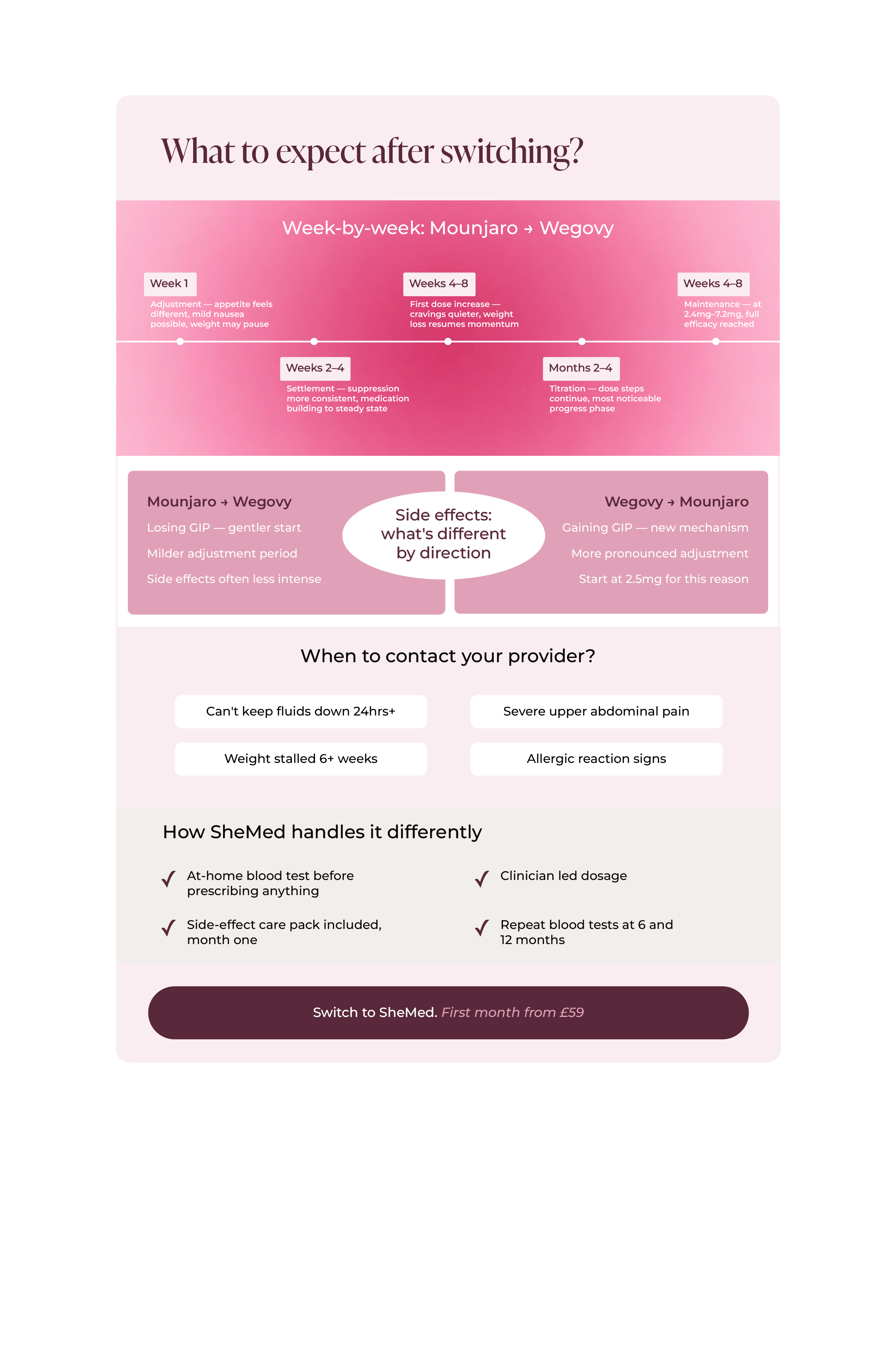
- Week 1 (first Wegovy dose) - Your body will start adjusting to the new mechanism. Your appetite may feel less ‘switched off’ and more ‘turned down’. Some mild nausea is common, particularly if you’re on 0.25mg–0.5mg. Weight loss may slow or pause temporarily.
- Weeks 2–4 - This is the end of the adjustment period. Your appetite suppression should start becoming more consistent and predictable.
- Weeks 4–8 (first dose increase) - This is where you may notice Wegovy’s effects more clearly. Your cravings may start becoming quieter and your weight loss should resume momentum. Your prescriber may review your dose here.
- Months 2–4 (titration continues) - Your prescriber may increase the dosage based on your response and tolerance. Most people experience their most noticeable weight loss progress during this phase.
- Month 4+ (maintenance dose) - At 2.4mg or approaching it, you’re at or near full efficacy. The STEP UP trial found Wegovy 2.4mg produced an average 17.5% weight loss at 72 weeks;
Wegovy 7.2mg (approved in the UK January 2026) produced 20.7% in similar trials. It is however recommended only to people with weight and BMI over a certain level.
Switching from Mounjaro to Wegovy: Real Patient Reviews
What Do Patients Say About Switching from Mounjaro to Wegovy?
We’ve pulled together some of the real patient experiences across UK communities and clinical programmes.
“The first two weeks felt like I’d lost my safety net. The appetite suppression on Mounjaro had felt almost effortless. Wegovy felt more like a gentle hand on my shoulder rather than a full off-switch. But by week five, I was in a proper rhythm and the results kept coming.”
“I was worried I’d regain everything. I didn’t. My weight actually kept going down, just at a slightly slower pace for the first month. By month three I’d lost more than I did in the same period on Mounjaro.”
“The side effects were less for me on Wegovy. Mounjaro gave me terrible nausea on the higher doses that never fully went away. On Wegovy I barely noticed anything.”
“Honestly, I wish I’d switched sooner. The cost difference alone was significant after the September price increase. And the results on Wegovy have been just as good for me personally.”
These may give you assurances about Wegovy. However, it is important to know that your weight loss journey will be as unique as you are.
Should I Switch from Mounjaro to Wegovy?
We believe that you should be the one deciding this first and then your prescriber. Because only you know how you felt during whilst taking Mounjaro.
Our job is to only make sure that you have all the information needed to make this decision.
Here are some reasons for why you wouldn’t to switch -
The SURMOUNT-5 trial, the first head-to-head comparison of the two medications, published in the New England Journal of Medicine in May 2025, found that tirzepatide (Mounjaro 15mg) produced 20.2% average weight loss at 72 weeks, compared to 13.7% for semaglutide (Wegovy 2.4mg). That’s a big difference.
But,
Wegovy 7.2mg has changed the comparison
The MHRA approved Wegovy 7.2mg in January 2026. The STEP UP trial found it produces 20.7% weight loss at 72 weeks, which is almost the same as with Mounjaro’s highest dose, 15mg.
Also,
Individual response varies significantly
Some women on Wegovy outperform the Mounjaro average. Others plateau on Mounjaro where they might have done better on Wegovy. The data you see is an average.
Wegovy has an additional licensed benefit Mounjaro doesn’t
NICE recommended Wegovy in April 2026 to reduce the risk of heart attacks and strokes in people with established cardiovascular disease. For women with relevant cardiac history, this may be a decisive clinical factor.
Wegovy can be cheaper
Mounjaro at 12.5mg –15mg now costs up to £330 per four-week pack after the September 2025 price increases. Wegovy at comparable efficacy doses is generally less expensive. The overall course cost may, however, be the same as you go up on Wegovy.
Side effects are individual
Neither medication is universally considered as worse or better. It’s about how well it suits your body.
Our honest recommendation would be, if you’re on Mounjaro and it’s working well, we would say, don’t switch. Even the trial data suggests there’s no strong clinical reason to switch for efficacy purposes alone.
But if cost, side effects, supply, or a clinical recommendation are pushing you toward Wegovy, switching may not be the worst option.
What Happens to Your Weight Loss After Switching
Based on clinical evidence and patient experience:
- Your weight loss plan will most probably continue - A well-managed switch doesn’t erase your progress. While you may have an initial adjustment period, weight loss typically continues after that.
- There may be a short plateau - As your body will be dealing with a new mechanism, it may take 2-4 weeks to get used to it. This is the adjustment period, not a sign the medication isn’t working.
- The longer-term trajectory will depend on the dose you reach - Both medications’ results are dose-dependent. Getting to your maintenance dose is where the meaningful clinical outcomes come from. Stopping too early in the titration process is the most common reason for underperformance.
- Some women actually see better results after switching - Trial averages give an indication but the results are always subjective. Some women respond more strongly to semaglutide than tirzepatide, or vice versa. The only way to know is to try, with proper clinical support.
Mounjaro 15mg: 22.5% average weight loss at 72 weeks (SURMOUNT-5, NEJM 2025). Wegovy 2.4mg: 13.7% average weight loss at 72 weeks (SURMOUNT-5). Wegovy 7.2mg: 20.7% average weight loss at 72 weeks (STEP UP, Lancet 2025). These are population averages. Individual results vary.
Managing Side Effects After Switching
The side effects that we’ve seen women experience are similar in both medications: nausea, constipation, diarrhoea, and occasionally vomiting. It’s just that switching adds an extra layer of adjustment -
- Switching to Wegovy from Mounjaro: You’re losing the GIP mechanism. The initial side effects may be mild, since you’re coming down in effective potency. Most women say that Wegovy feels ‘gentler’ in the early weeks.
- Switching to Mounjaro from Wegovy: You’re going from single action (GLP-1) to double action (GLP-1 + GIP). This new pathway can intensify the adjustment response. Starting at 2.5mg (the lowest available Mounjaro dose), hence, becomes very important here.
Tips that consistently help across both switches:
- Eat smaller portions, particularly on injection day.
- Avoid fatty or rich foods around the time of your injection.
- Stay well hydrated throughout the week.
- Don’t lie down immediately after eating.
- Take your injection on the same day each week.
Nausea management specifically: We’ve seen ginger tea, dry crackers, and peppermint work well. Eating protein-forward meals tends to reduce nausea more than carbohydrate-heavy meals. If nausea is severe, your prescriber may recommend anti-emetic medication in the short term.
When to Contact Your Provider After Switching Medication
While most side effects during a switch settle within a few weeks, there are specific situations where you should reach out to your clinical team promptly. They include -
- Severe or persistent nausea and vomiting. If you’re unable to keep food or fluids down for more than 24 hours, contact your provider. Dehydration can be a serious concern and requires medical attention.
- Severe abdominal pain. Sharp, severe, or persistent pain in the upper abdomen can be a sign of pancreatitis, a rare but serious side effect. In such a case, again, seek medical attention promptly. Do not wait for it to pass.
- Weight loss has completely stalled for more than 6 weeks - A short plateau is expected during the adjustment phase. But if you’ve been taking the new medication for six weeks or more, consistently (very important), and the scales haven’t moved at all, your clinician needs to know. The dosage may need adjusting.
- An uncommon side effect - Trust your instincts. If something feels medically wrong rather than ‘just a side effect’, tell your provider.
- Any allergic reaction - Rash, swelling, difficulty breathing, or a racing heart after your injection requires immediate medical attention.
You can also report side effects to the MHRA through the Yellow Card scheme, regardless of which medication you’re taking.
Quick Summary
- You will start Wegovy at a lower dose than your Mounjaro dose, 0.25mg to 1.7mg depending on where you were
- Your prescriber must decide your starting dose based on your history, tolerance, and blood results
- Wegovy may take at least 8–12 weeks before delivering results; the first 4 weeks are adjustment, not assessment
- SURMOUNT-5 (NEJM 2025) confirmed Mounjaro produces greater average weight loss (20.2% vs 13.7%), but newly approved Wegovy 7.2mg reaches 20.7%. But most importantly, individual responses vary widely.
- Most patients continue losing weight through a well-managed switch
- Side effects usually feel milder when switching from Mounjaro to Wegovy than the other way around
- You must contact your provider in case of severe abdominal pain, inability to keep fluids down, or a halted progress for more than 6 weeks
Learn more about the side effects, costs and difference in results between Mounjaro & Wegovy in our latest article.
Ready to take the next step? SheMed can support your weight loss journey
Frequently Asked Questions
What dose of Wegovy will I start on after Mounjaro?
There is no fixed conversion chart, but in general: 0.25mg–0.5mg for someone who've been on lower Mounjaro doses (2.5mg–5mg), 0.5mg–1mg for mid-range doses (7.5mg–10mg), and 1mg for higher doses (12.5mg–15mg). Your prescriber will, however, take the final call based on your individual clinical picture.
How long does it take for Wegovy to work after switching from Mounjaro?
Most women notice Wegovy’s effects clearly from weeks four to eight onward, with results building further as the dose increases over 16–20 weeks of titration.
Will I gain weight when switching from Mounjaro to Wegovy?
Not if the switch is well-managed. There may be a short plateau while your body adjusts to the new mechanism. While the pace of weight loss may change initially, most women continue to lose weight.
Is Mounjaro more effective than Wegovy?
In the SURMOUNT-5 head-to-head trial (NEJM 2025), Mounjaro produced 20.2% average weight loss versus 13.7% for Wegovy 2.4mg at 72 weeks. However, Wegovy 7.2mg (approved in the UK January 2026) produces 20.7% average weight loss at 72 weeks, which is comparable to Mounjaro’s highest dose. Individual responses, however, may be very different than these averages.
What do patients say about switching from Mounjaro to Wegovy?
The most common experience is a two-to-four week adjustment period with a subtler suppression feeling than Mounjaro, followed by results resuming and often picking-up as the dose increases. Some women also tolerate Wegovy better in terms of side effects.
What do patients say about switching from Wegovy to Mounjaro?
The early weeks are often more pronounced than expected as Mounjaro’s GIP mechanism is new to the body. Most women who push through that period report noticeably stronger appetite suppression and, for those who face a plateau on Wegovy, Mounjaro renews the progress.
When should I contact my provider after switching?
You must contact them in case of severe or persistent vomiting, severe abdominal pain, complete weight loss stall for more than six weeks, or anything that feels medically wrong.
Sources & Further Reading
1. SURMOUNT-5 Trial — Tirzepatide vs Semaglutide Head-to-Head, NEJM May 2025
2. SURMOUNT-1 Trial — Tirzepatide Once Weekly for the Treatment of Obesity, NEJM 2022
3. STEP UP Trial — Once-Weekly Semaglutide 7.2mg in Adults with Obesity (Lancet Diabetes & Endocrinology, 2025)
4. MHRA — GLP-1 Medicines for Weight Loss and Diabetes: What You Need to Know (GOV.UK, 2026)
5. NICE — Semaglutide to Reduce Cardiovascular Risk in Adults with Overweight or Obesity (April 2026)
6. NHS — Obesity Treatment Overview
7. MHRA Yellow Card — Reporting Medication Side Effects
8. SheMed — Switch to SheMed: Blood-Test-Included GLP-1 Programme
The content on the SheMed blog is provided for general informational and educational purposes only. While SheMed provides professional weight loss services and strives to ensure the information shared is accurate and up to date, we make no representations or guarantees as to its accuracy, completeness, or timeliness. This content should not be taken as personal medical advice or a substitute for consultation with a qualified healthcare provider. Always speak with your doctor or licensed medical professional about your individual health or medical needs before starting any new treatment or programme. Never disregard or delay seeking professional medical advice because of something you have read on this site. SheMed is not responsible for any actions you may take based on the information provided in this blog.
Related Articles