Calories in Medjool Dates: Nutrition, Benefits and How Many You Should Eat
Medically reviewed by Puja Vyas, Lead Clinical Pharmacist.
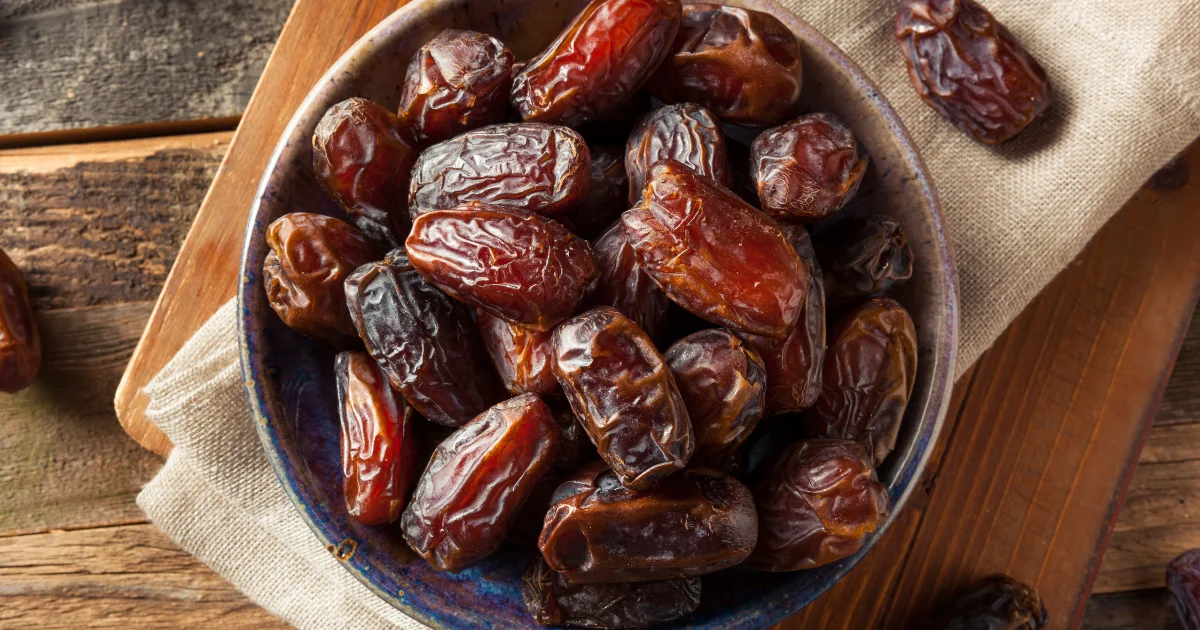
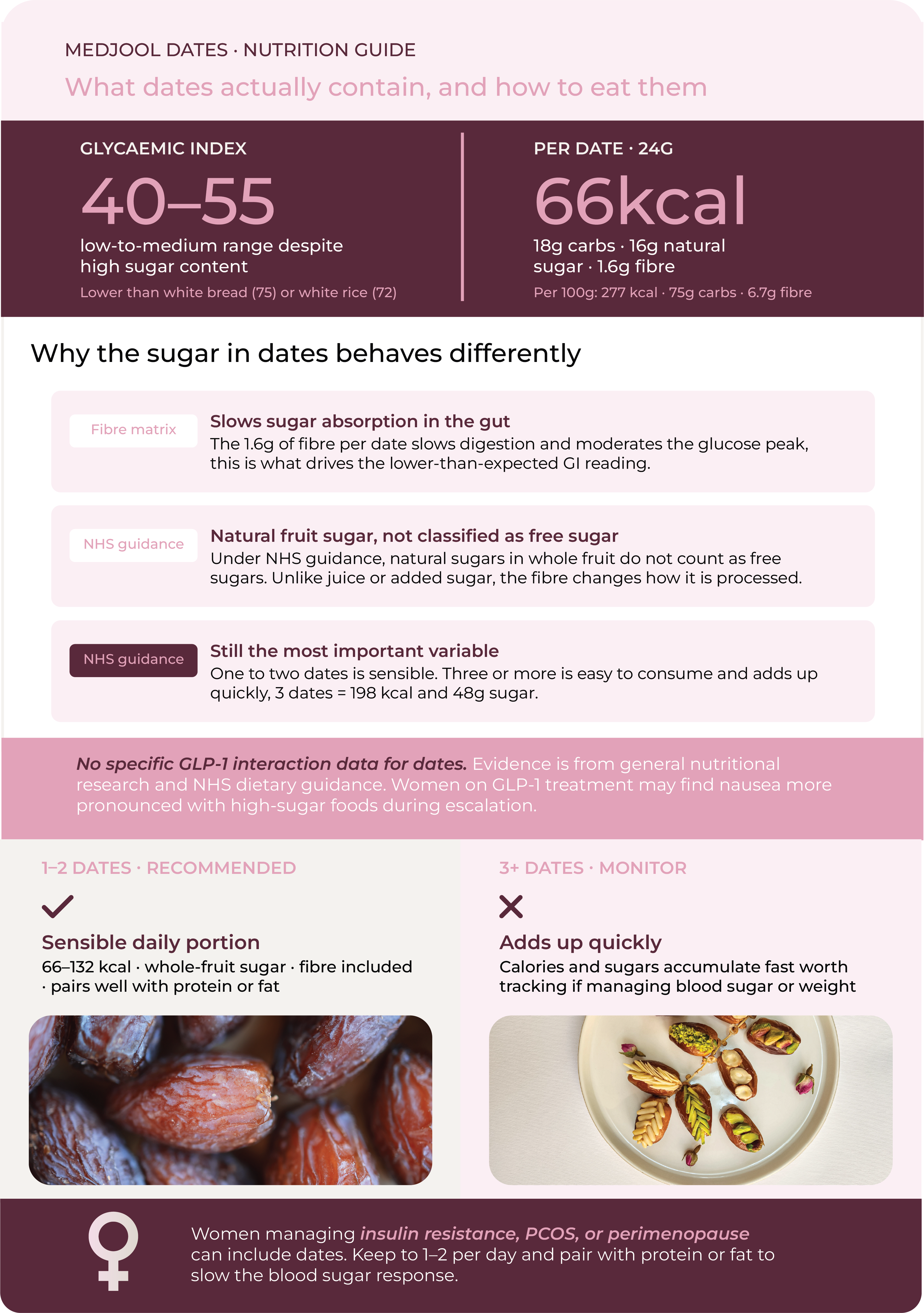
One Medjool date (roughly 24g, stone removed) contains 66 calories, 18g of carbohydrates, 1.6g of fibre, and 16g of natural sugar. Per 100g, you’re looking at around 277 calories. This means that Mejdool dates are quite nutritious, but at the same time very easy to eat more of than you intended.
We’ve tried to cover almost everything you need to know about this viral trend including the full nutrition picture, how they compare with other dates, their glycaemic index, and how they fit into weight management.
How Many Calories Are in a Medjool Date?
- 1 Medjool date (24g): 66 calories
- 2 Medjool dates (48g): 132 calories
- 3 Medjool dates (72g): 198 calories
You can do the math now.
To put this into context for you, a boiled egg or a small glass of semi skimmed milk contain a similar amount of calories. Eat two dates and you’re looking at something like a small pot of plain yoghurt.
Mejdool dates are not calorie-free, but they deliver fibre, minerals, and antioxidants alongside those calories. So, we can’t compare a biscuit with a similar calorie count to these dates.
Calories per 100g of Medjool Dates
With 277 calories per 100g, Medjool dates are more calorie-dense than most fresh fruits. A banana, for example, is around 89 calories per 100g, blueberries around 57 calories per 100g. But that’s not the right way to look at it, as you normally would eat only 1-2 of these dates at a time. So, the per-date figure is what matters most for practical portion planning.
Medjool vs Deglet Noor: Why Per-Date Comparisons Mislead
If you’ve seen some different date calorie numbers online, this is most probably why. Medjool and Deglet Noor are the two most common date varieties, but very different in size.
- Medjool date: roughly 24g and 66 calories per date, 277 calories per 100g
- Deglet Noor date: roughly 7g and 20 calories per date, 282 calories per 100g
While per 100g both are nearly identical, per date, a single Medjool has more than three times the calories of a single Deglet Noor. Simply because it is three times the size.
This is where knowing the difference between these two makes a big difference when a recipe says “add two dates”.
Medjool Dates Nutrition Facts (Full Breakdown)
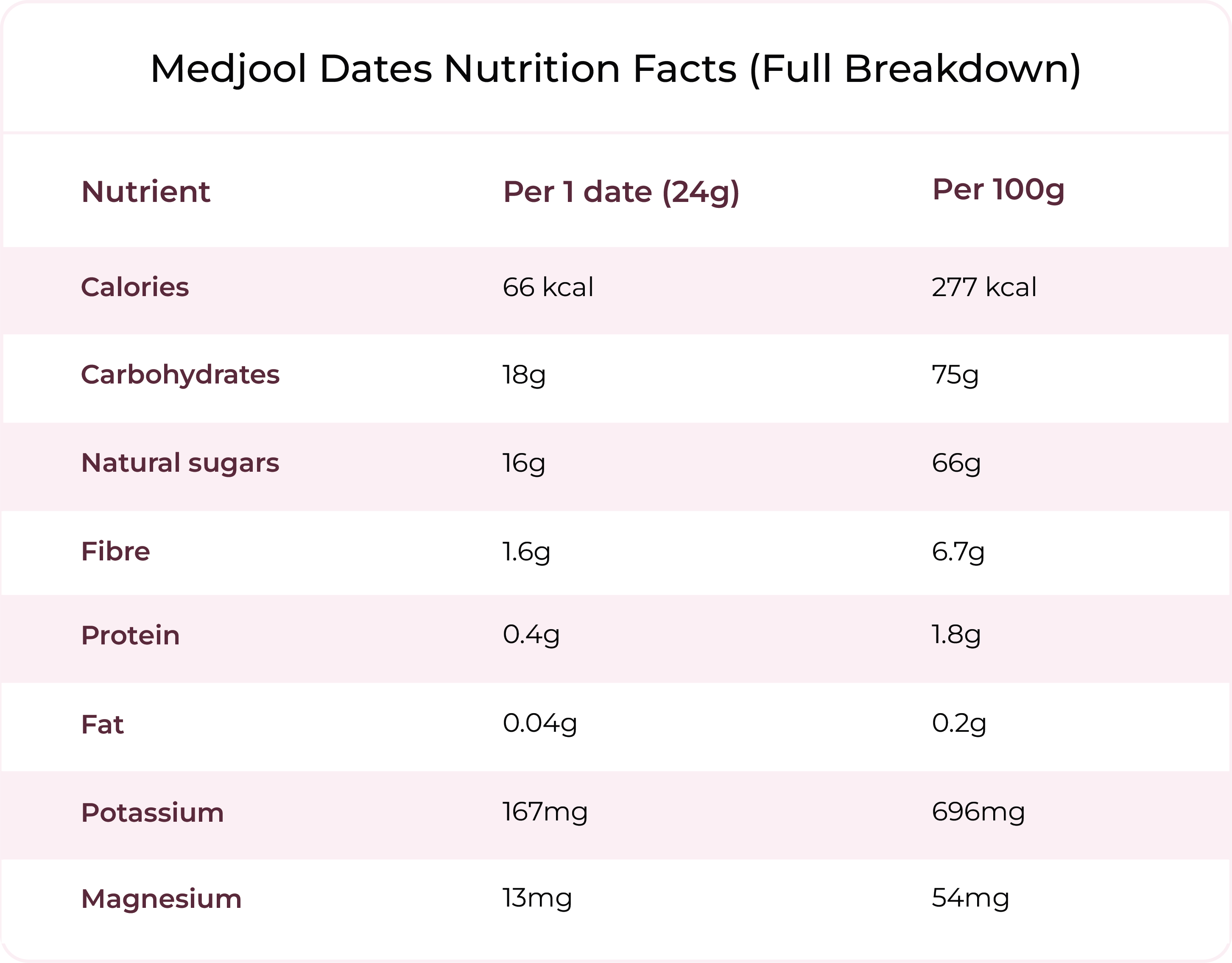
Source: USDA FoodData Central – Dates, Medjool (all nutrition data)
We’ve already talked about calories above. Let’s now look at the next ones in the list -
Carbohydrates and Natural Sugar
Carbs, that are almost from the natural sugars, fructose and glucose, form the majority of the calories. 16g of sugar per date can sound alarming, but only until you read the NHS guidance on free sugars.
The NHS defines free sugars as sugars added to foods, plus the sugars naturally present in fruit juices, smoothies, honey, and syrups. The natural sugar within whole fruit (including dates) is not classified as free sugar, because the fibre matrix of whole fruit slows its absorption.
This is important for you to know. Because metabolically, eating a whole Mejdool date is not the same as eating 16g of white sugar, even though the amount of sugar is similar.
Fibre Content
With 1.6g per date and 6.7g per 100g, Medjool dates are can provide a decent amount of fibre, both soluble and insoluble types. Soluble fibre slows digestion and helps moderate blood sugar response. Insoluble fibre supports digestive regularity. The NHS recommends 30g fibre intake per day for adults. This means that two dates can make up around 11% of your daily requirement.
Potassium, Magnesium and Other Minerals
Potassium is the standout micronutrient in Mejdool dates. 167mg per date or 696mg per 100g, is more than that of 100g banana (roughly 358mg per 100g). Potassium supports blood pressure regulation, nerve function, and muscle contraction.
Mejdool dates also contain 13mg per date of magnesium, which can contribute to energy metabolism and bone health. They also contain smaller amounts of calcium, iron, and phosphorus. None of these are present in quantities that make dates a primary mineral source, but they contribute meaningfully as part of a varied diet.
Vitamins and Antioxidants
Medjool dates contain vitamin B6, folate, and niacin, all B vitamins involved in energy metabolism. They also contain phenolic compounds and flavonoids with antioxidants. There’s research, limited though, that suggests that these antioxidants may have anti-inflammatory properties.
What Is the Glycaemic Index of Medjool Dates?
Low-to-Medium GI Despite High Sugar Content
Glycaemic index or GI is the measure used to denote how quickly a food item raises blood sugar compared to pure glucose. The published figures for Mejdool dates are around 40 to 55 depending on the study, ripeness of the dates tested, and methodology used.
A GI of 40 to 55 is considered to be low to medium. This is particularly notable in this case where 16g of the 18g of carbohydrates are sugars. The reason is fibre. The soluble fibre in dates forms a gel-like substance in the gut that slows sugar absorption, moderating the blood glucose spike relative to eating equivalent pure sugar.
Glycaemic Load: The More Useful Number for a Single Portion
The glycaemic load of a food item takes portion size into account along with GI, hence making it more relevant for real eating situations. The GL for one Medjool date can be calculated as 18 (gms of sugar per date) multiplied by 0.55 (the GI) divided by 100, giving roughly 9 to 10 per date.
A GL under 10 is considered low. Even with two dates, a range of 18 to 20 is considered medium. That means 1-2 dates is a sensible snackable portion.
Pairing Dates With Protein or Fat
If you add a small amount of protein or fat alongside a date, it can further flatten the blood sugar response by slowing gastric emptying. Here’s a recipe for a Mejdool date that is absorbed slowly and can keep you full for longer.
· Add a teaspoon of almond butter
· Pair with Greek yoghurt
· And a small piece of cheese
Are Medjool Dates Good for Weight Loss?
The Case for Dates
Dates contain fibre, potassium, antioxidants, and B vitamins in amounts that most processed sweet snacks do not. If you replace your processed and unhealthy biscuits, sweets, or other treats with dates, the result is usually a net positive: similar or lower calories with meaningfully better nutritional value.
The Case for Caution
Dates are bite sized and hence, you can end up eating more than intended without noticing. One date is a modest 66 calories. Four dates is 264 calories, and getting from one to four can take less than two minutes.
Unlike most fresh fruit, dates have very little water content, which means they do not create the same fullness per calorie that a piece of fresh fruit would. The fibre helps, but it has limits.

A Sensible Daily Portion
One to two dates can mean a good daily snack portion. Three to four can be justified only if you’re replacing it with something more calorie dense. You need to make sure you count them into your daily total rather than treating it as a free food.
NHS and Diabetes UK dried fruit guidance suggests around 30g as a portion, ideally eaten as part of a meal rather than as a standalone snack between meals, for dental health reasons.
Eating Dates While Managing Your Weight With GLP-1 Treatment
This one is for you if you’re currently on or considering GLP-1 medicines (semaglutide or tirzepatide), where the relationship between appetite, portion size, and calorie-dense foods like dates is slightly different from the general population.
Why Portion Size Matters Even More on GLP-1 Treatment
GLP-1 medicines work by reducing appetite and slowing gastric emptying. During the treatment, most women find that they naturally eat less at each meal and feel satisfied with smaller portions. In that context, one or two Medjool dates can represent a larger share of a reduced daily intake than it would for someone eating at full appetite.
Pairing Dates With Protein for Balance
We covered this shortly above as well. Anything paired with protein produces a slower blood sugar response and keeps you fuller for longer. In this case, you can pair a Mejdool date with a tablespoon of Greek yoghurt or a small handful of nuts. This matters more for women on GLP-1 as their total daily caloric intake is already reduced and nutrient density per calorie becomes very important.
Personalised Guidance
If you are on a GLP-1 programme and want to understand how to optimise your nutrition alongside treatment, it is worth having a conversation with your clinical team rather than relying on general guidance.
Everyone’s journey on GLP-1 is different. We understand the importance of tailoring advise based on your health and not just textbooks. Our oral semaglutide treatment → and clinician-led weight loss programme → both include ongoing clinical support alongside prescribing.
Other Health Benefits of Medjool Dates
Digestive Health
A small controlled study found that eating seven Medjool dates daily for three weeks significantly improved bowel movement frequency in healthy adults compared with a control group.
Heart Health Markers
Another research suggests that regular date consumption may have positive effects on cholesterol and triglycerides. However, it is important to note that dates alone cannot be a treatment for reducing cholesterol.
Pregnancy and Labour
There is some research that states that Medjool date consumption in the final weeks of pregnancy can have possible effects on cervical ripening and labour duration. This, again, is not conclusive. If you are pregnant, we recommend discussing all diet changes with your midwife or doctor.
Who Should Be Cautious With Medjool Dates?
Type 2 Diabetes and Blood Sugar Monitoring
Even with 16g sugar, Medjool dates can fit into a diabetic diet in moderation. Diabetes UK's dried fruit guidance allows around 30g as a portion, ideally at mealtimes rather than between meals. It also emphasises that portion control matters more for dried fruit than for fresh fruit because it is more concentrated. People with type 2 diabetes should monitor their blood sugar response to dates and discuss portion sizing with their diabetes care team.
Kidney Conditions
Medjool dates are high in potassium (696mg per 100g). People with kidney disease following a potassium-restricted diet or who take medications that affect potassium levels should take particular care with dates and discuss specific limits with their healthcare team.
Grass Pollen Allergies
People with grass pollen allergy may also react to dates as date pollen can cross-react with grass pollen. You may symptoms like itching or tingling in the mouth, which are typical oral allergy syndrome rather than severe systemic reactions. If you develop any oral symptoms when eating dates, it is worth discussing with an allergy specialist.
How to Add Medjool Dates to Your Diet
Here are some tips to include dates without turning a snack into a calorie surplus:
- Stuffed with nut butter: halve the date, remove the stone, add a teaspoon of almond or peanut butter. Protein and healthy fat moderate the sugar hit.
- Chopped into porridge: one date, finely chopped, added to a bowl of rolled oats provides natural sweetness without needing added sugar or honey.
- Blended into a date paste: three to four dates blended with a little warm water creates a natural sweetener for baking or stirring into yoghurt. The calorie count remains similar, but the serving size can get smaller per use.
- With yoghurt and nuts: one date alongside a small pot of Greek yoghurt and a handful of walnuts makes a balanced snack with fibre, protein, and healthy fat.
For more practical nutrition guidance: our diet and nutrition blog →
Frequently Asked Questions
How many calories are in one Medjool date?
One Medjool date (approximately 24g, stone removed) contains 66 calories. Almost all of those calories come from natural sugars, with 16g of sugar and 18g of total carbohydrates per date.
How many calories are in 100g Medjool dates?
100g of Medjool dates, approximately four dates, contains 277 calories. Per 100g, these dates also contain 75g of carbohydrates, 66g of natural sugars, and 6.7g of fibre.
Are Medjool dates good for weight loss?
They can be, in modest portions. Dates provide fibre, minerals, and antioxidants, making them a more nutritious choice than most processed sweet snacks at a similar calorie count. The risk is their calorie density and ease of eating several at once. One to two dates as part of a balanced diet is okay, but eating four or more regularly without accounting for the calories is where problems can start.
What is the glycaemic index of Medjool dates?
Medjool dates have a glycaemic index of roughly 40 to 55, depending on the study and ripeness. This puts them in the low-to-medium range. The fibre content slows sugar absorption, moderating the blood glucose response.
How many Medjool dates should I eat a day?
One to two dates is the portion size most commonly supported by nutrition guidance. NHS and Diabetes UK dried fruit guidance uses around 30g as a standard portion, which equates to roughly one large Medjool date.
Are Medjool dates fattening?
Not inherently, but they are calorie-dense for their size. At 66 calories each, a small handful adds up quickly. The natural sugar they contain does not count as free sugar under NHS guidance, and the fibre makes them more satiating than pure sugar. They fit well into a weight-conscious diet in one-to-two date portions, counted as part of your daily intake.
How much sugar is in a Medjool date?
One Medjool date contains 16g of natural sugar, predominantly fructose and glucose. Per 100g, Medjool dates contain approximately 66g of natural sugars. The NHS does not classify this as free sugar because it is the naturally occurring sugar within a whole fruit rather than added or extracted sugar.
Sources and Further Reading
1. USDA FoodData Central – Dates, Medjool (primary nutrition data source)
2. NHS – Sugar: The Facts (free sugars and whole fruit guidance)
3. Diabetes UK – Fruit, Vegetables and Diabetes (UK dried fruit portion guidance)
4. Healthline – Medjool Dates: Nutrition, Benefits and Uses (medically reviewed)
5. WebMD – Medjool Dates: Are There Health Benefits?
6. Medical News Today – Medjool Dates: Definition, Nutrition and Benefits
7. NHS inform Scotland – Sugar and Dried Fruit Guidance
The content on the SheMed blog is provided for general informational and educational purposes only. While SheMed provides professional weight loss services and strives to ensure the information shared is accurate and up to date, we make no representations or guarantees as to its accuracy, completeness, or timeliness. This content should not be taken as personal medical advice or a substitute for consultation with a qualified healthcare provider. Always speak with your doctor or licensed medical professional about your individual health or medical needs before starting any new treatment or programme. Never disregard or delay seeking professional medical advice because of something you have read on this site. SheMed is not responsible for any actions you may take based on the information provided in this blog.
Related Articles