

Mounjaro Dosage Chart: Doses, Injection Sites and Pricing
Medically reviewed by Puja Vyas, Lead Clinical Pharmacist.
Last reviewed 16/10/2026
You’ll start Mounjaro at 2.5mg once a week and go through a gradual increase up to a maximum of 15mg, spending roughly four weeks at each level. Most women start seeing a difference by weeks 4 to 8, with meaningful weight loss typically building from the 5mg dose onwards.
In this article, we’ve covered the full dose schedule, what each step feels like, the best places to inject, what to eat, how long it stays in your system, and what it costs.
Key Takeaways
- Mounjaro starts at 2.5mg and escalates through six steps to a maximum of 15mg, with approximately four weeks at each dose
- 2.5mg is a starter dose, but many people do see significant results with it and stick to it for long term
- Most women start noticing effects in weeks 4 to 8. Meaningful weight loss usually follows the 5mg step
- The three main treatment doses are 5mg, 10mg, and 15mg. Some women find their ideal maintenance dose before reaching 15mg
- The best injection sites are the abdomen (at least 5cm from the navel), outer thigh, and upper arm. Rotate each week
- Mounjaro has a half-life of approximately five days, meaning it stays in your system for around four to five weeks after the last dose
The Full Mounjaro Dose Escalation Schedule
Starting Dose and Why Titration Matters
Mounjaro dosage begins at 2.5mg and it stays there for the first four weeks. This is not because 2.5mg starts producing weight loss, but for your body to get familiarised with tirzepatide gradually. This helps in reducing the nausea and digestive discomfort significantly, which otherwise would create problems if you jumped on the higher, weight-loss causing dose.
Four weeks at each step is a minimum. However, based on how well your body adjusts, your clinician may suggest staying longer at a given dose if you are responding well or if side effects need more time to settle.
Each Dose Step, From 2.5mg to 15mg
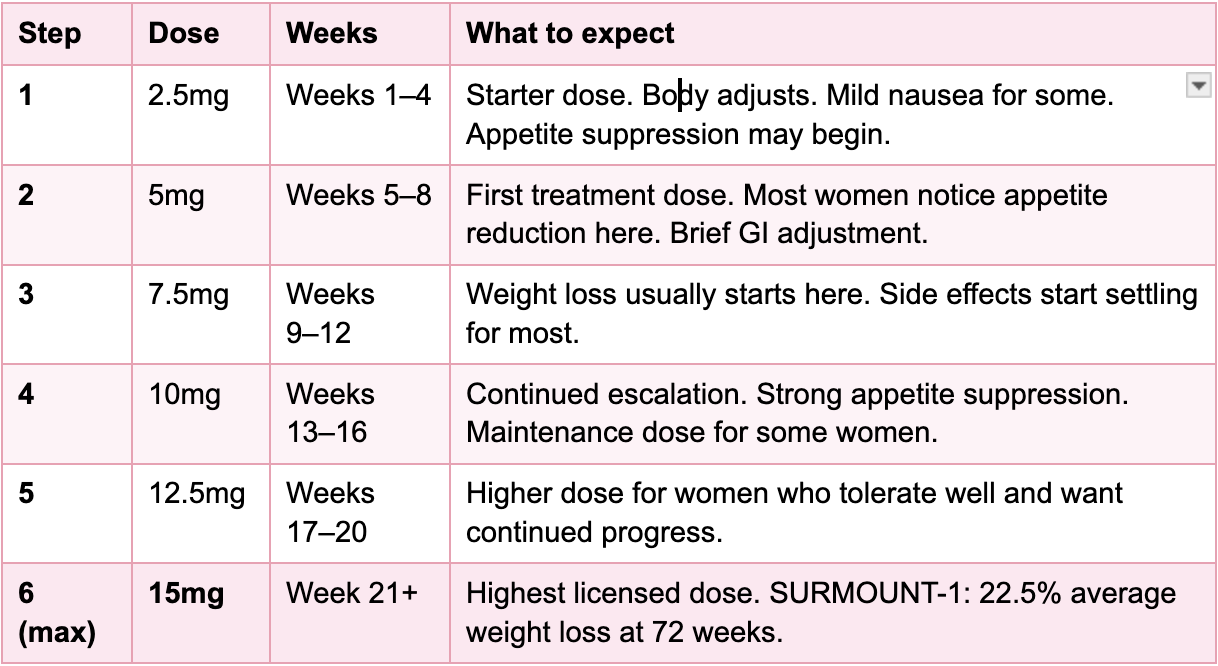
Table showing the Mounjaro dose escalation schedule across six steps. Step 1, 2.5mg, weeks 1 to 4, starter dose as the body adjusts, with mild nausea for some and appetite suppression possibly beginning. Step 2, 5mg, weeks 5 to 8, the first treatment dose where most women notice appetite reduction, with brief GI adjustment. Step 3, 7.5mg, weeks 9 to 12, where weight loss usually starts and side effects begin settling for most. Step 4, 10mg, weeks 13 to 16, continued escalation with strong appetite suppression, acting as a maintenance dose for some women. Step 5, 12.5mg, weeks 17 to 20, a higher dose for women who tolerate treatment well and want continued progress. Step 6, the maximum licensed dose of 15mg, from week 21 onwards, associated with 22.5 percent average weight loss at 72 weeks in the SURMOUNT-1 trial.
Switching From Another GLP-1 Instead of Starting Fresh?
If you’ve been on or are currently on Wegovy and are wanting to try Mounjaro, we’ve written a dedicated article for you -
Switching from Mounjaro to Wegovy: what to expect →
On the 2.5mg first month: it is completely normal to feel like nothing is happening in week one or two. You are eating your usual amount, the appetite suppression has not kicked in yet, and the dose is genuinely not therapeutic. Some women worry they are on the wrong dose or the medication is not working.
It is working exactly as it should.
The body needs this time. The shift in appetite that most women describe comes at 5mg, not 2.5mg, and it is usually noticeable.
How Quickly Does Mounjaro Start Working?
What to Expect in the First Few Weeks
This is what the sequence may look like for you, as it does for most women –
- Week one and 2 - Quiet. No major change happening in any area
- End of month one – Some appetite suppression begins
- Dose increases to 5mg – Effect becomes more pronounced. You’ll see a noticeable shift. Food will seem less distracting, portion sizes will reduce naturally, and the urge to eat outside meals will also ease.
You may not see a drop in the number on the weighing scale yet, which is okay. The scale usually catches up over the following weeks rather than simultaneously. It’s normal to see resulsts after 8 weeks as it builds up a steady state in the blood.
Why Results Vary by Dose and Individual
While the above journey gives you an overview of the picture, your journey will be unique. Even if you know someone who has been on the same dose of Mounjaro for the same number of weeks, the weight loss will not necessarily be the same.
Multiple factors, including starting metabolic health (particularly insulin resistance), how consistently the injection is taken, dietary habits, activity level, sleep quality, stress, and how well the body responds to tirzepatide, specifically play a role in shaping the journey.
SURMOUNT-1 found 22.5% average weight loss at 72 weeks at 15mg. Average means some women lost more, some less. What matters here more is the trend over your own weeks on treatment rather than the headline figure.
You can read about how Mounjaro works in the body here: how does Mounjaro work? →
Where to Inject Mounjaro
Best Injection Sites and How to Rotate Them
Mounjaro is a subcutaneous injection, meaning it goes into the fatty tissue just under the skin and not inside your veins. There are three licensed sites:
- Abdomen: the most commonly used site. Inject at least 5cm away from the navel, in any direction. Avoid any scar tissue
- Outer thigh: the middle outer section of either thigh. Easy to reach and comfortable for most women
- Upper arm: the back or outer section of the upper arm. You may need some assistance for this site
Injecting in the same spot repeatedly can build up scar tissue that reduces absorption. Therefore, it is recommended to use a different site or a different area within the same site, moving at least 2 to 3cm from the previous injection point.
Avoid When Injecting
- Into skin that is red, broken, bruised, or tender
- The 5cm zone around the belly button
- Areas with visible lumps, hardness, or scar tissue from previous injections
- Into muscle rather than fat: the needle should go into the pinched subcutaneous layer, not deeper
Here’s a step-by-step injection manual: where to inject Mounjaro: injection sites and rotation guide →
What to Eat on Mounjaro
Appetite Changes Affect What and How Much You Eat
Mounjaro slows your stomach emptying. This means that you’ll feel full sooner and for longer. Your portion sizes will reduce, often substantially. So, eating the same volume as before will cause nausea and discomfort.
This is how the medicine is designed to work. The point is to ensure that you eat food that is nutritious enough to support your body during a period of reduced intake. Protein at every meal, for example, becomes very important, because you are eating less overall, but you will still need to preserve your muscles.
Eating Tips During Dose Escalation
- Smaller meals, eaten slowly: This is the most effective way to reduce nausea on Mounjaro. Large meals on a slowed digestive system are uncomfortable. Just remember ‘Half the plate, twice the time’
- Protein first: Eat more eggs, fish, chicken, Greek yoghurt, legumes. You need protein to support muscle retention and to keep you fuller for longer within reduced portions
- Low-GI carbohydrates: Choose oats, sweet potato, lentils, quinoa rather than white bread or sugary cereals. Mounjaro improves insulin sensitivity. Pair it with low-GI eating, and you’ll amplify it further.
- Hydration: It can get easy to forget to hydrate yourself when you are eating less. Add reminders or whatever else works for you, but drink enough water between meals.
- Avoid very fatty or rich foods in the early weeks: Fatty foods are the biggest culprit for nausea triggers on GLP-1 medicines, especially in the first few weeks. Your tolerance will mostly improve as the dose settles
Here’s a full-fledged article on a full diet guide for women on GLP-1 treatment: what to eat on Mounjaro: diet tips that actually work →
How Long Does Mounjaro Stay in Your System?
Mounjaro (tirzepatide) has a half-life of approximately five days. In simple terms, it would take around four to five days for the drug to get fully cleared from your system after the last dose.
This means that if you miss a dose, you’ll still have a good level of medication in your system for several days. And if you stop Mounjaro to switch to another GLP-1 medicine, or get pregnant, you’ll have to factor in the clearance period.
In case you’re switching from Mounjaro to Wegovy, you can read more about it here: Switching from Mounjaro to Wegovy: what to expect →
And here’s another article to tell you more about what to do if you miss a dose: can you overdose on Mounjaro? Missed doses and what to do →
What Each Mounjaro Dose Costs
We’ll just talk about the cost of Mounjaro on SheMed
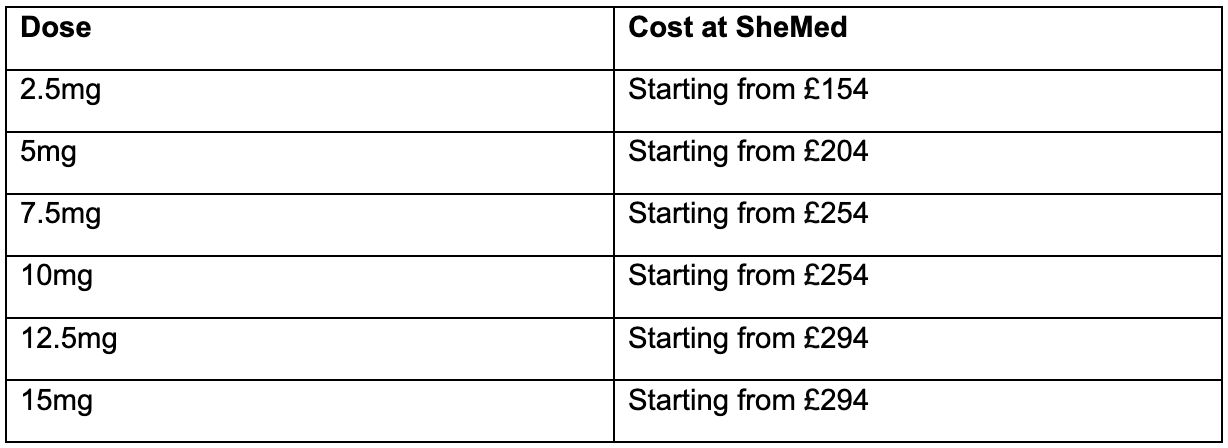
At SheMed, we price Mounjaro by the dose, with the cost increasing as the dose increases to reflect the medication cost at each level.
We don’t believe in cold transactions. For us, every woman is a part of our family for whom we will ensure the best care and guidance.
When Your Clinician Might Adjust Your Dose
The dose escalation schedule is a recommendation, not a mandate. Your clinician may recommend you stay at a dose for more than four weeks if side effects need more time to settle, or if your blood test results flag something worth monitoring before going higher. They may do that also if your body is showing strong results at the current dose, giving you no reason to escalate.
Going up a dose is not automatic. For some women, 5mg or 7.5mg may deliver exactly what they were looking for with excellent tolerability. For others, growth may plateau at a lower dose, hence demanding escalation.
The goal is to ensure the right individual journey.
Here are some more related articles we’ve written if you’re more curious:
When to increase your GLP-1 dose: how to know and what to expect →
Is Mounjaro safe? What we need to know →
Ready to take the next step? SheMed can support your weight loss journey
Frequently Asked Questions
What is the highest dose of Mounjaro?
The highest licensed dose of Mounjaro in the UK is 15mg once weekly. This is the dose that found 22.5% average weight loss at 72 weeks during the SURMOUNT-1 trial.
How long does it take for Mounjaro to work?
Most women notice a shift in appetite between weeks 4 and 8, usually after the dose increases to 5mg. The weight change follows in the weeks after. Full therapeutic benefit builds over months, not weeks. The 22.5% average weight loss figure comes from 72 weeks of treatment, not eight.
What is the best place to inject Mounjaro?
The abdomen is the most commonly used site, injected at least 5cm from the navel. The outer thigh and upper arm are also licensed sites. It is recommended to rotate between sites every week and vary the exact spot within each site to prevent scar tissue build-up that reduces absorption.
Why am I not losing weight on Mounjaro 5mg?
Several factors influence how well Mounjaro works at any given dose, including how long you have been on it, dietary habits, exercise, sleep quality, stress levels, and your individual metabolic picture. If you have been on 5mg for four or more weeks and are not seeing the results you expected, you must consult your clinician before deciding to change the dose. Your prescriber can review your blood tests, assess whether escalation is appropriate, and identify any factors affecting your response.
What happens if I miss a Mounjaro dose?
If you miss a dose and your next scheduled injection is more than four days away, you can take the missed dose as soon as you remember. If your next injection is in four days or fewer, it’s better to skip the missed dose and resume your normal weekly schedule. Never take two doses in one week.
Sources and Further Reading
1. Eli Lilly / EMC – Mounjaro (Tirzepatide) UK Summary of Product Characteristics
2. MHRA – Mounjaro (Tirzepatide) Regulatory Approval
3. Jastreboff AM et al. – SURMOUNT-1: Tirzepatide for the Treatment of Obesity. NEJM. 2022;387:205–216
4. NICE – Tirzepatide (Mounjaro) for Weight Management
5. SheMed – How Does Mounjaro Work?
6. SheMed – When to Increase Your GLP-1 Dose: How to Know and What to Expect
7. SheMed – Is Mounjaro Safe? What We Need to Know
8. SheMed - Missed a Mounjaro Dose? What to Do 1, 2, 3 or 4 Days Late
The content on the SheMed blog is provided for general informational and educational purposes only. While SheMed provides professional weight loss services and strives to ensure the information shared is accurate and up to date, we make no representations or guarantees as to its accuracy, completeness, or timeliness. This content should not be taken as personal medical advice or a substitute for consultation with a qualified healthcare provider. Always speak with your doctor or licensed medical professional about your individual health or medical needs before starting any new treatment or programme. Never disregard or delay seeking professional medical advice because of something you have read on this site. SheMed is not responsible for any actions you may take based on the information provided in this blog.
Related Articles