Is Retatrutide Better Than Mounjaro? What the Evidence Can (and Can’t) Tell You

Retatrutide and Mounjaro are both from Eli Lilly, and both target weight-loss hormones. One of them produces results that rival bariatric surgery. But only one can be prescribed in the UK today.
We are seeing many Reddit threads and discussions on other forums on retatrutide, where people are getting increasingly curious about the new drug and are trying everything to get their hands on it, including settling for non-approved illegal versions from random labs. This is very risky and we advise against it.
In this article, we’ve covered what makes retatrutide different from Mounjaro, what these trial numbers are that are generating all the buzz, why the comparison is more complicated than a single percentage, and what the one unexpected side effect means for you if you are considering it in the future.
Key Takeaways
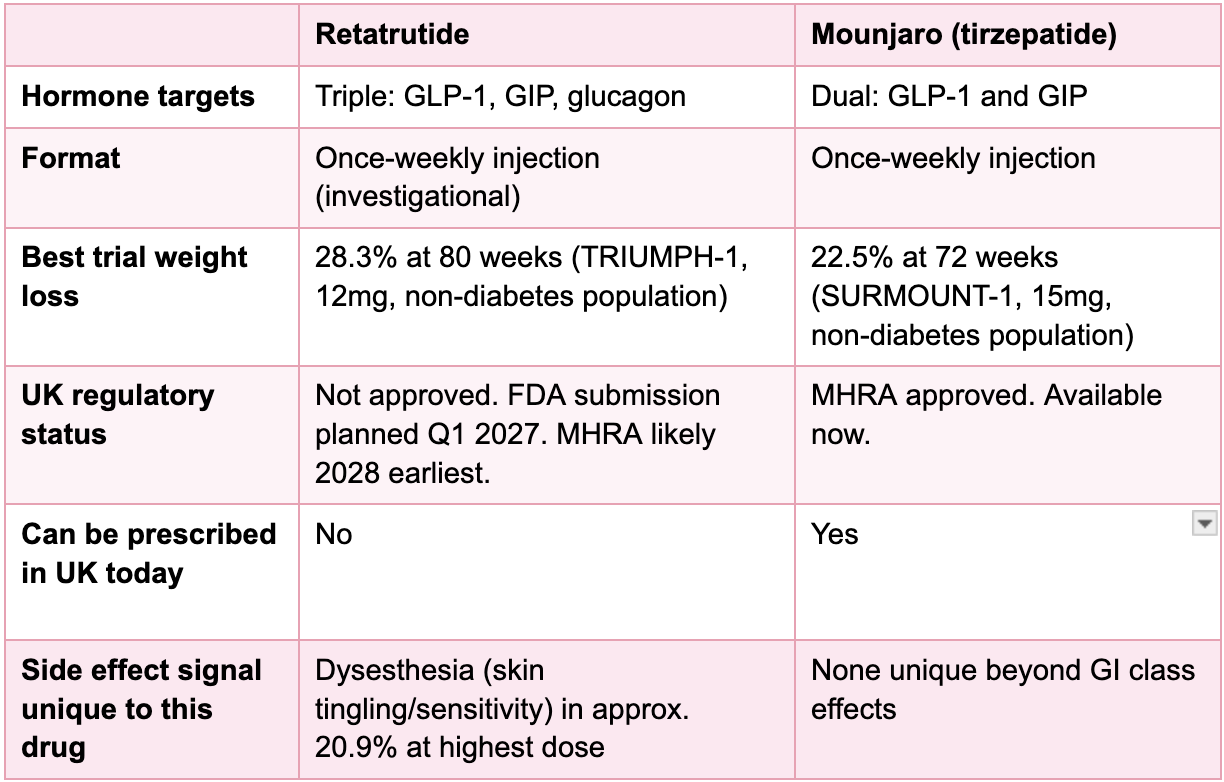
- Retatrutide targets three hormones (GLP-1, GIP, glucagon) versus Mounjaro’s two (GLP-1, GIP)
- TRIUMPH-1 (May 2026) showed 28.3% average weight loss at 80 weeks on 12mg retatrutide in non-diabetes adults, with 45.3% achieving 30%+ weight loss
- Mounjaro’s best trial result is 22.5% at 72 weeks (SURMOUNT-1, 15mg). These are from different trials with different populations and cannot be compared directly
- Retatrutide is not MHRA-approved, not FDA-approved, and cannot be legally prescribed in the UK. Eli Lilly plans to submit to the FDA in Q1 2027; UK availability is estimated 2028 at the earliest
- Retatrutide has one additional safety signal not seen with Mounjaro: dysesthesia (skin tingling or sensitivity), affecting approximately 20.9% of participants at the highest dose in trials
- Mounjaro is available today through a clinician-led programme including a free at-home blood test
How Does Retatrutide Differ From Mounjaro?
Why a Third Hormone Target Changes the Mechanism
Mounjaro is a dual agonist that works on GLP-1 and GIP receptors. GLP-1 signals your brain when you’re full and slows digestion, and GIP improves insulin sensitivity while adding a second layer of appetite regulation. This dual mechanism is the reason it outperforms single GLP-1 medicines like Wegovy on average weight loss.
Retatrutide comes with an addition: the glucagon receptor. Glucagon signals your liver to release stored glucose and fat for energy. By activating it along with the other two hormones, retatrutide turns up your body’s energy expenditure directly on top of appetite suppression.
The Triple Agonist Mechanism Explained
Put simply, the glucagon component increases the number of calories your body burns at rest. When you combine this with reduced appetite from GLP-1 and improved insulin sensitivity from GIP, you eat less and burn more.
However, right now this information doesn’t help much because retatrutide is not available to prescribe. It does show the future of obesity medicine, though, and it looks promising.
Is Retatrutide More Effective Than Mounjaro?
Why Trial-Stage Results Can’t Be Compared Directly to Real-World Data
You may have seen most articles say plainly that Retatrutide is more effective than Mounjaro. But they forget to mention that the TRIUMPH-1 trial and the SURMOUNT-1 trial (Mounjaro’s pivotal study) enrolled different people, ran for different durations, used different dosing protocols, and had different dropout rates.
We cannot directly compare a 28.3% figure from one trial and a 22.5% figure from another, as they were not measured under the same conditions. It’s like saying one restaurant's pasta is better than another's because it got more stars, without mentioning one was reviewed by Michelin and the other by your mum.
Mounjaro also comes with years of real-world prescribing experience, while Retatrutide’s figures are from a controlled trial where every dose is tracked and every participant is closely followed. Real-world outcomes in any medicine are usually a bit lower than trial results.
Having said that, the TRIUMPH data is genuinely striking.
The Evidence
- TRIUMPH-1 (May 2026): 2,339 adults without diabetes. 28.3% average weight loss at 80 weeks on the 12mg dose. 45.3% of participants achieved at least 30% weight loss, a level previously associated with bariatric surgery. At the 4mg dose, reached with a single escalation step, average weight loss was 19.0%.
- TRIUMPH-4 (December 2025): Adults with obesity and knee osteoarthritis. 28.7% average weight loss at 68 weeks at the highest dose and reduction in OA pain.
- TRIUMPH-2 and 3 (July 2026): Adults with type 2 diabetes and cardiovascular disease. Up to 22.6% weight loss at 80 weeks, with significant improvements in blood sugar control.
To compare, Mounjaro’s best trial figures are 22.5% at 72 weeks (SURMOUNT-1, 15mg, non-diabetic adults). This is the highest for any licensed medicine and is in the same range as the figures for Retatrutide’s diabetes and cardiovascular population results (22.6%). Retatrutide’s non-diabetes population results (28.3%) exceed it significantly, but again, both are different trials.
The honest version of this comparison: Retatrutide’s trial numbers are very encouraging. If they translate into real-world prescribing anywhere near as well as tirzepatide’s did, this will be a genuinely significant step forward for women who haven’t achieved the results they needed with current medicines. But we do not know that yet.
What we know is that the trials look very promising and the medicine is not available. Mounjaro’s 22.5% in trials translates into real, meaningful, clinician-monitored weight loss right now. This is the decision that most women are making right now.
🔗 Source: Eli Lilly – TRIUMPH-2 and TRIUMPH-3 Phase 3 Topline Results (23 July 2026)
Can You Get Retatrutide in the UK?
Why Retatrutide Isn’t Approved Yet
Retatrutide has not yet received FDA approval or MHRA authorisation despite five positive Phase 3 trials. Eli Lilly, the manufacturer of the drug, plans to submit a Biologics License Application to the FDA in Q1 2027.
Looking at the standard FDA review timeline of 6 to 10 months, the US approval date can be expected by late 2027 at the earliest. The approval by MHRA, the UK’s FDA equivalent, usually follows FDA by 6 to 12 months. This means that the earliest realistic UK availability is not before 2028.
You can read more about the availability timeline and what to know about buying retatrutide online here: buying retatrutide online in the UK: what to know →
What ‘Not Yet Approved’ Actually Means
It means that you cannot buy retatrutide legally in the UK right now and no prescriber can prescribe it. Any website or service currently offering retatrutide in the UK is not supplying a licensed medicine. If you opt for such a drug, you are risking unknown purity, concentration, and safety profile outside a clinical trial setting.
We know that many of you who are searching ‘retatrutide vs Mounjaro’ are really asking: can I get it yet? The answer is a plain and simple no, not yet. Mounjaro is the closest available alternative by mechanism, and it is available now.
Are the Side Effects Different?
The Shared GI Profile
Both Retatrutide and Mounjaro share a similar side effect profile that typically occurs during dose escalation: nausea, diarrhoea, constipation, vomiting, and reduced appetite. They usually ease as your body gets used to the drugs. This pattern is consistent across all GLP-1 and dual/triple agonist medicines and is the primary reason dose escalation schedules exist.
The One Side Effect Retatrutide Has That Mounjaro Doesn’t
Retatrutide’s trial data showed one side effect that was not as commonly seen with Mounjaro: dysesthesia. This is a neurological sensation described as skin tingling, numbness, or unusual sensitivity. It is not painful in most cases, but noticeable. Approximately 20.9% of the participants in Phase 3 trials experienced it at the highest 12mg dose.
We don’t know the cause fully yet, but it looks like it may be because of the glucagon receptor activity and its effect on neurological pathways. The important thing to know here is that no serious neurological outcomes were reported, and they usually got resolved without any intervention. The MHRA and FDA will scrutinise this carefully as part of their regulatory review.
Why Mounjaro’s Safety Profile Is Better Established
Millions of patients globally have been prescribed Mounjaro since its approvals in the US in 2022 and the UK in 2024. We know that it’s safe to use in the real world, outside of the clinical trials. There are post-marketing surveillance, pharmacovigilance reports, and clinical experience across diverse populations that prove its safety.
All we know about Retatrutide’s safety is through its Phase 3 trials. While it does not make it unsafe, it does mean that there is no real-world evidence behind it yet.
Retatrutide vs Mounjaro: Side by Side
Which One Can You Actually Start Today?
Between Retatrutide and Mounjaro, only the latter is available to prescribe in the UK right now. Retatrutide is not.
What This Means If You Are Deciding Now
If you’re weighing your options for which GLP-1 medicine to go ahead with, the question shouldn’t be Mounjaro or Retatrutide. The real question is Mounjaro or waiting till 2028, or probably even later, for retatrutide to go through regulatory approval and reach UK private prescribing.
While you may be attracted to Retatrutide’s superior numbers, you could achieve much more in the time that you currently have with Mounjaro. And there is a chance that even Mounjaro may not be right for you, and Wegovy would be. What you can achieve with these medications is dependent on your health picture, eligibility, and your goals.
This is where a clinician-led assessment that includes a blood test that gives the full metabolic picture before prescribing anything helps.
You can check your eligibility here: Mounjaro at SheMed →
And here’s an article if you want to compare all current UK options: Mounjaro vs Wegovy: which is right for you → and weight loss pills that work in the UK →
The best available option, with the clinical oversight it deserves. SheMed prescribes Mounjaro with a free at-home blood test covering thyroid, HbA1c, cholesterol, and liver enzymes before anything is prescribed.
Clinician-led. Blood test first. Only from £59 for your first month.
Frequently Asked Questions
Is retatrutide better than Mounjaro?
Retatrutide’s Phase 3 data shows higher average results than Mounjaro’s pivotal trial. But these are different trials with different populations, durations, and conditions, so a direct comparison overstates the certainty. What’s fair to state is that Retatrutide’s triple-agonist mechanism represents a genuinely different approach, and its trial numbers are the highest seen in obesity medicine to date.
What is the difference between retatrutide and Mounjaro?
Mounjaro activates two hormone receptors: GLP-1 and GIP. Retatrutide activates three: GLP-1, GIP, and glucagon. Glucagon turns up energy expenditure directly, not just appetite suppression. Retatrutide’s trial data show higher average weight loss.
Can I get retatrutide instead of Mounjaro in the UK?
No. Retatrutide is not MHRA-approved and cannot be legally prescribed in the UK. Any UK service or website claiming to offer it is not supplying a regulated medicine. Eli Lilly plans to file for FDA approval in Q1 2027; UK availability is estimated no earlier than 2028.
What is the difference between retatrutide and orforglipron?
Both are new Eli Lilly weight loss medicines, but they are at very different stages. Orforglipron (Foundayo) is a once-daily tablet that was MHRA-approved in the UK on 10 August 2026 and can be prescribed now. Retatrutide is a once-weekly injection still in clinical trials, with no FDA or MHRA approval yet and UK availability unlikely before 2028.
What is dysesthesia with retatrutide?
Dysesthesia is a neurological sensation of skin tingling, numbness, or unusual sensitivity. It was identified as a side effect in retatrutide Phase 3 trials, affecting approximately 20.9% of participants at the highest dose of 12mg. It is not painful and was resolved in most cases without intervention in trials. Its cause and long-term significance are still being studied.
When will retatrutide be available in the UK?
Eli Lilly plans to submit a Biologics License Application to the FDA in Q1 2027. FDA approval is expected in late 2027 if everything follows on time. MHRA approval in the UK typically comes 6 to 12 months after FDA approval, which puts the earliest realistic UK availability at 2028. The timelines can change depending on the regulatory review process.
Sources and Further Reading
1. Eli Lilly – TRIUMPH-1 Phase 3 Topline Results (21 May 2026)
2. Eli Lilly – TRIUMPH-2 and TRIUMPH-3 Phase 3 Topline Results (23 July 2026)
3. PharmExec – Retatrutide Delivers Up to 22.6% Weight Loss in Two New Phase III Trials (July 2026)
4. AJMC – Retatrutide Achieves Up to 30.3% Average Weight Loss in Phase 3 TRIUMPH-1 Trial
6. Jastreboff AM et al. – Tirzepatide Once Weekly for the Treatment of Obesity (SURMOUNT-1). NEJM 2022
7. MHRA – Medicines and Healthcare Products Regulatory Agency: Drug Approval Status
The content on the SheMed blog is provided for general informational and educational purposes only. While SheMed provides professional weight loss services and strives to ensure the information shared is accurate and up to date, we make no representations or guarantees as to its accuracy, completeness, or timeliness. This content should not be taken as personal medical advice or a substitute for consultation with a qualified healthcare provider. Always speak with your doctor or licensed medical professional about your individual health or medical needs before starting any new treatment or programme. Never disregard or delay seeking professional medical advice because of something you have read on this site. SheMed is not responsible for any actions you may take based on the information provided in this blog.
Related Articles

