Menopause Testing: Blood Tests, Home Kits and What They Show
Medically reviewed by Puja Vyas, Lead Clinical Pharmacist.
If you are over 45 and are seeing symptoms or perimenopause or menopause, you do not need a blood test to confirm. NICE guidance states clearly that diagnosis in this age group is made on symptoms alone.
Blood tests are needed only in specific situations, like if you are under 45, your symptoms are unclear or if you want to rule out other conditions that can mimic menopause.
Here’s what actually gets tested, what the results mean, and where at-home kits genuinely help.

Do You Need a Test to Confirm Menopause?
Why Menopause Over 45 Is Diagnosed by Symptoms, Not Blood Tests
For women aged 45 and above, perimenopause and menopause are diagnosed clinically if there are symptoms like irregular periods, hot flushes, night sweats, mood changes, and sleep disruption. Both NHS and NICE have confirmed this.
This is because during perimenopause, hormone levels, particularly FSH (follicle-stimulating hormone), fluctuate so dramatically that a single blood test can give entirely misleading results. So, you could basically test on a day with elevated FSH and it may look like menopause to you. But do it after three weeks and you’ll see the levels back to the normal perimenopause phase.
The symptoms, however, stay consistent across the same period even when the blood test doesn’t.
Having said that, there are some situations though, when a blood test is a better option.
Here’s When a Blood Test Is Recommended
- You are between 40 and 45 with symptoms: Your GP should consider an FSH test to support the diagnosis alongside your symptoms. Early menopause in this age group needs more clinical confirmation.
- You are under 40 with symptoms: Here testing becomes very important because premature ovarian insufficiency (POI) needs to be confirmed or excluded with two FSH tests taken 4 to 6 weeks apart.
- Your symptoms are atypical or unclear: If you can really not tell clearly whether the symptoms are menopausal or related to some other condition, a broader blood test can help.
- You are on combined oral contraception: The pill suppresses FSH, making a test unreliable. In such a case, your GP will need to consider other approaches.
- You want to rule out conditions that mimic menopause: Thyroid disorders, iron deficiency, and vitamin D deficiency all produce overlapping symptoms. A test can help confirming.
What Does a Menopause Blood Test Measure?
FSH (Follicle-Stimulating Hormone)
FSH is a hormone that your pituitary gland sends to your ovaries to trigger egg development. Your ovaries, gradually, stop listening to FSH with age. So, the pituitary gland tries shouting by producing more of it. Higher FSH levels therefore mean that your ovaries are producing less oestrogen.
The postmenopausal reference range from NHS pathology laboratories is 25.8 to 134.8 IU/L. For POI diagnosis in women under 40, NICE recommends two readings above 30 IU/L taken 4 to 6 weeks apart rather than relying on one result. During perimenopause, a single FSH reading can swing between premenopausal and menopausal ranges within weeks, which is why one test is not enough.
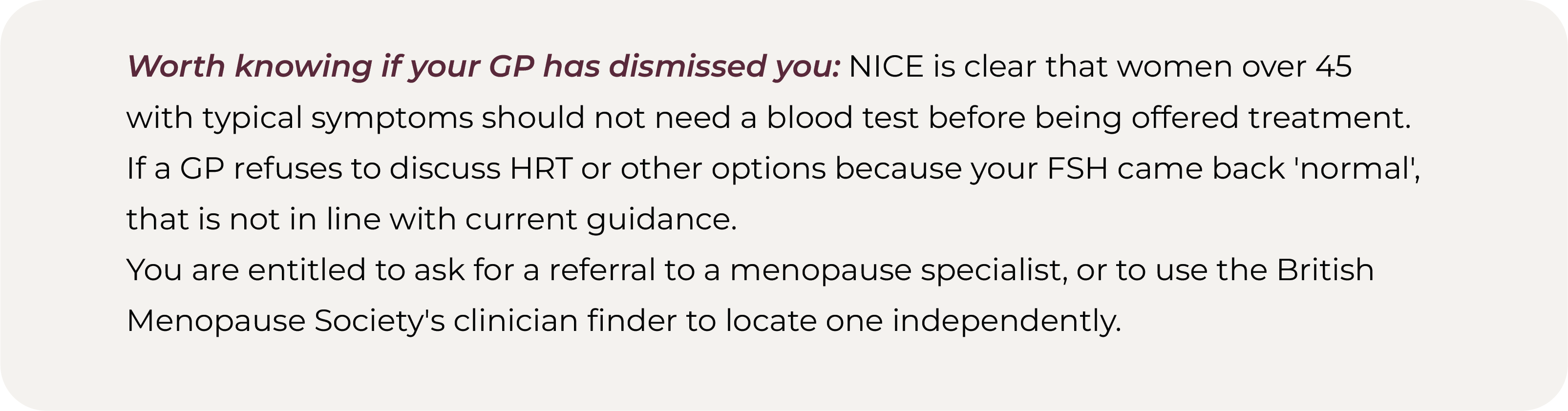
Important to know: The reference ranges vary between laboratories. Your result should always be interpreted by a clinician who knows your age, symptoms, and clinical picture, not compared against an online chart in isolation.
Oestrogen (Oestradiol)
Oestradiol is the main form of oestrogen that your ovaries produce. It keeps declining as your ovarian function reduces. Its levels fluctuate significantly across the menstrual cycle in premenopausal women.
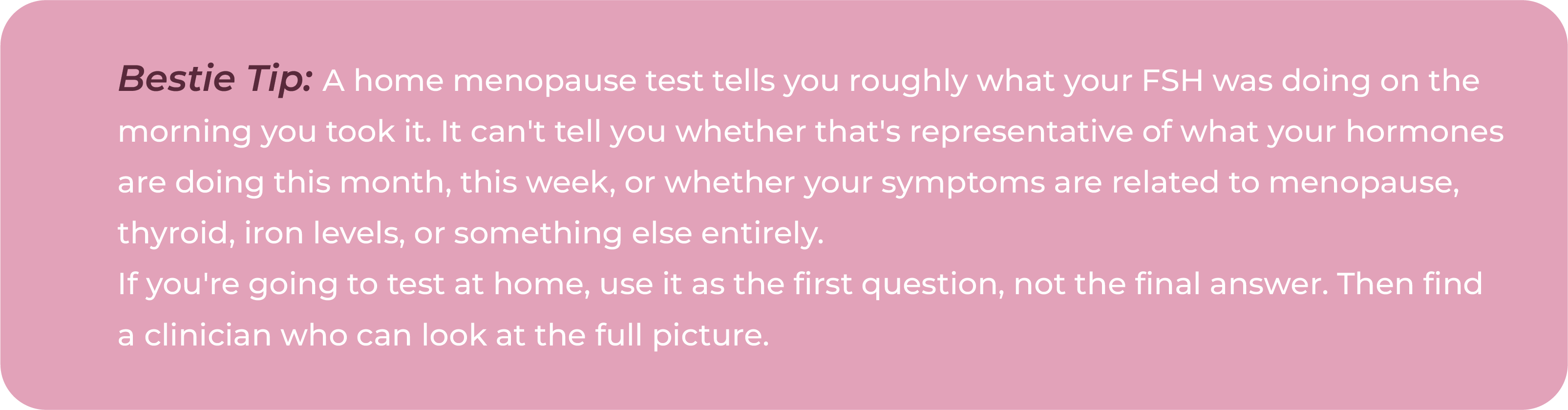
After menopause, levels are consistently low. Low oestradiol + high FSH levels gives a clear picture than either test alone. But again, a single snapshot may not be enough at times during perimenopause.
Other Tests Done Alongside
These are mainly done to identify other conditions that produce very similar symptoms to menopause. They include -
- Thyroid function (TSH): Fatigue, mood changes, weight changes, sleep disruption and palpitations; both underactive and overactive thyroid produce these symptoms that are very similar to perimenopause. Thyroid disorders are common in women and are frequently missed or attributed to 'just menopause'.
- Iron (ferritin): iron deficiency causes fatigue, brain fog, and poor sleep, and tends to worsen in perimenopause as periods become heavier. Ferritin, not just the standard iron level, is the more sensitive marker.
- Vitamin D (very common widespread in the UK, where sunshine is as scarce as a warm Bank Holiday: Low vitamin D brings fatigue, low mood, joint pain, and bone density loss. All of these, again, overlap with menopausal symptoms.
- HbA1c and fasting glucose: insulin resistance increases during the menopause transition and can go undetected without testing. It is important to know your glucose picture, especially if you are managing weight or considering GLP-1 treatment.
Did managing weight during menopause sound like you? Know more about menopause and weight gain: why it happens and what actually helps →
At-Home Menopause Test Kits: What They Can and Can't Tell You
Why a Single Home Test Can Be Misleading
At-home menopause tests, available from most UK pharmacies for around £15 to £30, measure FSH in a urine sample. They can give you a useful data point, but they cannot give you a diagnosis.
The fact that even a single GP blood test cannot be reliable because of fluctuating FSH levels across weeks, makes the reliability of a single home test more than questionable. A positive home test result (indicating elevated FSH) does not confirm menopause. A negative result does not rule out perimenopause.
We are not trying to criticise the tests here. It is simply the nature of what perimenopause does to hormone levels.
There are scenarios where a home-test can genuinely help though -
Where a Home Test Genuinely Helps
For women who are finding it difficult to access or advocate for GP support, a positive home test result provides a concrete data point to initiate a clinical conversation. It is a starting point, not a conclusion.
The test showing elevated FSH is most useful when it forces you to get a full clinical assessment done, not when it’s used as a conclusive diagnosis of your condition.
How SheMed's Approach Is Different
At-Home Blood Screening Plus Clinician Review
SheMed starts with a full at-home blood test with every plan before anything is prescribed. A venous blood draw that gets processed in an accredited laboratory, and gets tested for thyroid function, HbA1c, liver enzymes, cholesterol, and other metabolic markers depending on your clinical picture.
The results are then reviewed by a clinician who knows your history and symptoms, not by an algorithm. This is the difference between a number on a screen and clinical interpretation.
For women in the menopause transition, where thyroid disorders, insulin resistance, and iron deficiency frequently co-exist and worsen symptoms, that broader picture matters a lot.
Know more about SheMed treatment plans →
Why This Matters If You Are Also Managing Weight
Weight gain is the most common complaint we get by menopausal women. It’s because they are fighting biology and not willpower during that phase. Metabolic changes including insulin resistance, declining oestrogen, muscle loss are the ones driving it.
Now, these are not separate from the hormonal picture. For women who are eligible for GLP-1 medications as part of their weight management, knowing their thyroid function, HbA1c, and cholesterol baseline before starting treatment is both safer and more informative.
Know more about Wegovy pill → and perimenopause and GLP-1 agonists →
What Happens After a Test
Discussing Results With NHS GP
Trying to interpret results on your own is never the right approach. The result can say ‘normal’ or ‘abnormal’ against a reference range. But it needs to be interpreted using the context of your age, symptoms, cycle changes, and other health factors.
You must ask your GP what each result means for you specifically, not just whether it falls within the normal range.
Next Steps Depending on Results
- Over 45, symptoms clearly perimenopause: As per NICE guidance, treatment discussion can and should happen without waiting for hormone test result. Treatment options include HRT, lifestyle support, and where appropriate, clinical weight management.
- Under 45 with elevated FSH confirmed on two tests: early menopause or POI diagnosis, with referral to a specialist and urgent consideration of HRT to protect bone and cardiovascular health.
- Thyroid abnormality: referral or treatment for the thyroid condition itself, which may resolve some symptoms independently.
- Low ferritin or vitamin D: supplementation, with follow-up testing to confirm levels have improved.
Full overview: menopause symptoms, causes and what to expect →
Related: average age of menopause in the UK →
Want to learn more? We’ve got you! Keep reading.
Explore more from SheMed's menopause series:
Menopause symptoms and causes → menopause-symptoms |
Average age of menopause → average-age |
Menopause and weight gain → menopause-weight |
HRT for menopause → hrt-guide |
Symptoms beyond hot flushes → more-symptoms
Frequently Asked Questions
Can a blood test confirm perimenopause?
Not reliably, because FSH levels fluctuate dramatically during perimenopause. A single elevated FSH reading does not confirm it, and a normal reading does not rule it out. For women over 45, NICE guidance says perimenopause should be diagnosed on symptoms alone. Blood tests are more useful for women under 45, or under 40 where premature ovarian insufficiency needs to be confirmed.
Are home menopause test kits accurate?
They accurately measure FSH in a urine sample at the moment of testing. But, hormone levels fluctuate week to week. So, a positive result is not a confirmed diagnosis, but a useful conversation starter with a clinician.
What is a normal FSH level for menopause?
NHS pathology laboratories give a postmenopausal reference range of 25.8 to 134.8 IU/L. For POI diagnosis in women under 40, two FSH readings above 30 IU/L taken 4 to 6 weeks apart are required. Reference ranges vary slightly between laboratories, so results should always be interpreted by a clinician alongside your symptoms and history, not compared against an online reference table in isolation.
Do I need a blood test before starting HRT?
Not if you are over 45 with typical symptoms. NICE NG23 is clear that treatment should not be delayed pending blood test results in this group. Where blood tests do add value is in checking for conditions that might affect treatment decisions, particularly thyroid function and metabolic markers. Ask your clinician what they recommend for your specific situation.
How much does a menopause blood test cost privately in the UK?
Private menopause hormone panels typically range from around £50 to £150 depending on what is included. A basic FSH and oestradiol test is at the lower end. Panels that include thyroid, ferritin, vitamin D, and metabolic markers cost more. SheMed includes a full at-home blood test with every plan at no additional cost.
Sources and Further Reading
1. NICE NG23 – Menopause: Identification and Management (updated 2024)
2. NHS – Menopause and Perimenopause Overview
3. British Menopause Society Patient Information Leaflet (January 2026)
4. NHS inform Scotland – Signs and Symptoms of Menopause
5. NHS Pathology Laboratories – FSH Reference Ranges
6. National Institute on Aging – What Is Menopause?
The content on the SheMed blog is provided for general informational and educational purposes only. While SheMed provides professional weight loss services and strives to ensure the information shared is accurate and up to date, we make no representations or guarantees as to its accuracy, completeness, or timeliness. This content should not be taken as personal medical advice or a substitute for consultation with a qualified healthcare provider. Always speak with your doctor or licensed medical professional about your individual health or medical needs before starting any new treatment or programme. Never disregard or delay seeking professional medical advice because of something you have read on this site. SheMed is not responsible for any actions you may take based on the information provided in this blog.
Related Articles

