Weight Loss Drugs in the UK: A Clinician-Led Guide to Weight Loss Medication

We now have more licensed weight loss drugs in the UK than ever before. You already had two injectable options, two daily tablets, and one over-the-counter capsule. And now, because of the approval in 2026, you’ve got two new oral medications as well.
This article is for you if you have been trying to figure out what is actually available, what works, and whether you might be eligible.
Key Takeaways
· The UK now has four prescription weight loss medications: Mounjaro, Wegovy (injection and tablet) and Foundayo, plus Alli over the counter.
· GLP-1 medications work by reducing appetite and improving insulin sensitivity, not by speeding up your metabolism.
· NHS access exists but is limited. Most people start via a private prescription while NHS availability expands.
· Women with PMOS or going through perimenopause may respond especially well to GLP-1 medications.
· Compare your options and check eligibility at SheMed.
Let’s begin with the most fundamental question -
What Are Weight Loss Drugs?
Weight loss drugs are prescription (or, in one case, over-the-counter) medications that support weight management in people who meet clinical eligibility criteria. They are neither a shortcut nor a hack. Rather, they are clinically tested medications that work best alongside changes to diet and activity, and under medical supervision.
Weight Loss Drugs vs Weight Loss Medication: Is There a Difference?
No. Drugs and medications are interchangeable words in this context. "Drugs" tends to be the everyday search term while "medication" is the clinical one.
We see many people get confused and end up picking up wrong information from the internet. So, in this article, whenever you see either of these words, know that they are the same.
How Do Weight Loss Drugs Work?
GLP-1 Receptor Agonists (Semaglutide)
GLP-1 or glucagon-like peptide-1 receptor agonists work by mimicking a hormone that your gut naturally releases after eating. It tells your brain when it’s full, asking you to stop eating. They slow gastric emptying, reduce appetite, and improve how your body handles blood sugar.
Semaglutide, which is an active ingredient in both the Wegovy injection and the Wegovy pill, works this way.
You can read more about them in our detailed article: What Are GLP-1 Receptor Agonists and How Do They Work?
Dual GLP-1 and GIP Agonists (Tirzepatide)
Dual receptors work with GLP-1 and GIP (glucose-dependent insulinotropic polypeptide). Tirzepatide, the active ingredient in Mounjaro, is one of them. GLP-1 slows digestion and reduces appetite, while GIP improves how your body stores and uses energy. GIP may also enhance the appetite-suppressing effect of GLP-1.
This dual action produces stronger and more sustained weight loss than either pathway alone. This is the reason why Mounjaro has outperformed single-receptor GLP-1 medications in clinical trials.
Here’s a detailed article we’ve written on How Does Mounjaro Work?
Lipase Inhibitors (Orlistat)
Orlistat blocks roughly a third of the fat you eat from being absorbed in the gut. It does not affect your appetite. Unlike GLP-1 drugs that are prescription-only, Orlistat is available on prescription as 120mg or over the counter as Alli (60mg). It is the oldest option, and the results are usually on the lower side as compared to GLP-1 medications.
Which Weight Loss Drugs Are Licensed in the UK?
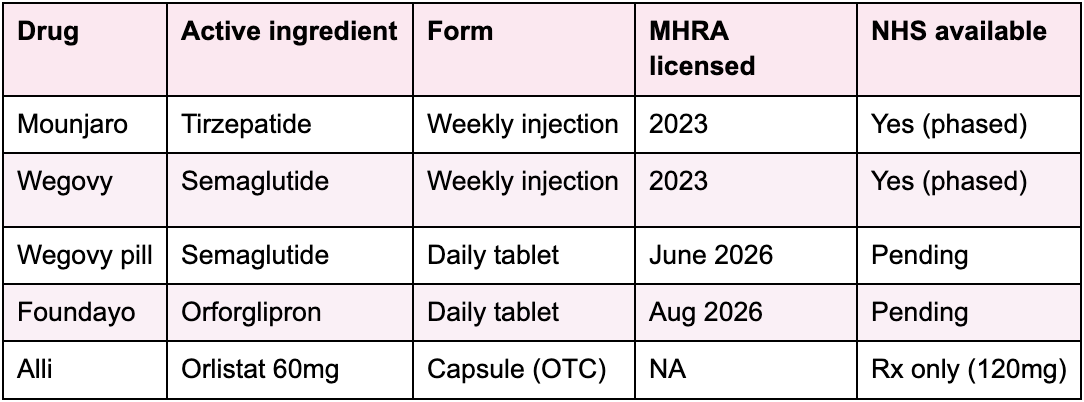
As of late 2026, there are four prescription weight loss medications licensed by the MHRA, plus one OTC option. Here is a summary:
Weight Loss Injections
Tirzepatide (Mounjaro)
Mounjaro is currently licensed in the UK as a once-weekly injection for weight management. It achieved the highest average weight loss of 22.5% over 72 weeks in the SURMOUNT-1 trial. It is currently the most effective licensed option, in terms of average weight loss, in the UK. Learn more about Mounjaro at SheMed.
Semaglutide (Wegovy Injection)
Wegovy is another once-weekly licensed injection like Mounjaro. Its active ingredient, semaglutide, produced an average weight loss of 14.9% over 68 weeks in the STEP-1 trial. It was the first GLP-1 injection to be licensed for weight management in the UK. Learn more about Wegovy at SheMed.
Weight Loss Tablets
Semaglutide Tablet (Wegovy Pill)
The oral tablet version of semaglutide was approved in the UK in June 2026, becoming the first GLP-1 tablet licensed here for weight management. It comes as a daily tablet. The 25mg dose, its highest, produced an average weight loss of 13.6% over 64 weeks in the trials.
It is a good option for someone not wanting to inject themselves. You can explore or read more about Wegovy pill UK: approval and what it means for you.
Orforglipron (Foundayo)
Foundayo (orforglipron) is another daily oral GLP-1 pill that is now approved by the MHRA in the UK. It’s gaining popularity because, unlike the Wegovy pill, it does not require fasting, making it suitable for busier routines.
Here’s Foundayo on SheMed. And here’s if you want to read more about Orforglipron (Foundayo): UK availability, price and NHS status.
Orlistat
Orlistat 120mg is available on prescription, while the 60mg version (branded Alli) can be bought over the counter at a pharmacy without a prescription. It works differently from GLP-1. It blocks fat absorption rather than reducing appetite. Its results are modest when compared to GLP-1 options.
Over-the-Counter Weight Loss Drugs
Alli (orlistat 60mg) is the only licensed over-the-counter weight loss product in the UK. You may find products calling themselves “fat burners” or herbal weight loss drugs”, but they are not assessed for efficacy by the MHRA.
We’ve covered their safety quotient below.
Are Weight Loss Drugs Available on the NHS?
Yes, but access is limited and phased. The NHS has stated clinical criteria for people to be eligible for weight loss medication. And even if you meet the criteria, the availability depends on your area and local integrated care board, as it is limited and being phased.
NHS Access and NICE Criteria
NICE TA1026 sets out the NHS criteria for tirzepatide (Mounjaro) and semaglutide (Wegovy):
· A BMI of 35 or above, plus
· at least one weight-related health condition, with lower thresholds for some ethnic backgrounds.
Access is being rolled out in phases through specialist weight management services, not through standard GP prescribing. You can read more about Mounjaro’s NHS availability here: Can You Get Mounjaro on the NHS?
Private Prescriptions
Private prescription is currently the preferred option for most people in the country. Only a registered prescriber, a GMC-registered doctor or other regulated clinician can provide one after a proper consultation. A prescription issued without a consultation or medical history review is not compliant with UK regulations.
Who Can Take Weight Loss Medication?
Eligibility
Adults with a BMI of 30 or above, or a BMI of 27 to 29.9 alongside at least one weight-related health condition such as type 2 diabetes, high blood pressure, or high cholesterol are currently eligible for licensed GLP-1 medications. Your prescriber will assess your medical history, current medications, and any contraindications before starting treatment.
Considerations for Women
Women with PMOS (formerly PCOS) and those going through perimenopause often find that standard diet and exercise advice underwhelms because of the underlying hormonal and metabolic picture. GLP-1 medications help address the main culprit directly: insulin resistance. This makes them particularly relevant for this group.
Read more about Mounjaro and PCOS.
How Effective Are Weight Loss Drugs?
- Mounjaro (tirzepatide): up to 22.5% average weight loss over 72 weeks in SURMOUNT-1 (highest dose, on-treatment estimand).
- Wegovy injection (semaglutide): approximately 14.9% over 68 weeks in STEP 1 (treatment-policy estimand).
- Wegovy pill (oral semaglutide): 13.6% over 64 weeks at the 25mg dose (treatment-policy estimand).
- Foundayo (orforglipron): phase 3 results expected; phase 2 showed meaningful weight reduction.
All the figures we’ve mentioned come from controlled individual trials. You should not consider them as head-to-head comparisons, as the trials used different populations, durations, and endpoints.
However, we understand that you may want to know the similarities and differences of these medications and what they mean for you. Hence, we’ve written detailed articles on - Mounjaro vs Wegovy & Foundayo vs Mounjaro vs Wegovy Pill.
Weight Loss Drug Side Effects and Safety
Common and Serious Side Effects
Most commonly seen side effects on GLP-1 medications are nausea, loose stools, and constipation. They are mostly seen in the early weeks of each dose increase and settle with time. Serious but rare risks include pancreatitis and gallbladder problems. If you’re too worried about side effects, you can read more about Which GLP-1 Has the Least Side Effects?
Unlicensed Products and How to Spot Unsafe Sellers
You may find many “weight loss jabs” online, but most of them are unlicensed medicines, probably research chemicals and compounded products sold without a proper prescription. They are not subject to MHRA oversight and carry serious risks.
We recommend you buy only from a GPhC-registered pharmacy with a GMC-registered prescriber. And before that, we also recommend you read our guide to fake weight loss jabs and black market risks.
Eating Well Alongside Weight Loss Medication
All the medication options that we’ve written about above work best when combined with a well-balanced diet. GLP-1 medications reduce appetite significantly, which means it becomes important for you to ensure your protein and micronutrient intake.
We feel the below articles may be useful for you if you’re considering these medicines -
Supplements to take alongside Mounjaro
Creating a balanced meal plan on GLP-1 Medications
High-protein eating for weight loss.
How to Choose the Right Weight Loss Medication
There is no single "best" weight loss drug. What’s best for you is what’s right for you based on your medical history, lifestyle, how you feel about injections versus tablets, and whether you have any conditions like PMOS or type 2 diabetes.
A prescriber will help you work through this. Compare options at SheMed.
How to Get Weight Loss Medication with SheMed
SheMed is a UK-based weight loss service provider tailored for women. Your journey with SheMed starts with an online health assessment, followed by a blood test before you start. This way, your prescriber has a complete understanding of your metabolic health, not just your BMI.
Over 100,000 women have started treatment through SheMed. Check your eligibility and start your assessment.
Ready to Find Out If You're Eligible?
SheMed's online assessment takes a few minutes. A blood test is included before you start, and a UK-registered clinician reviews your results.
Check out - shemed.co.uk/treatment.
Ready to take the next step? SheMed can support your weight loss journey
Frequently Asked Questions
What are the best weight loss drugs in the UK?
The best weight loss drug for you depends on your health history and preferences. Tirzepatide (Mounjaro) has produced the strongest average weight loss in trials to date. A prescriber can help you identify the most appropriate option. Compare at SheMed.
Can you get weight loss drugs on the NHS?
Yes, but access is limited. NHS access follows NICE criteria (BMI 35+ with a comorbidity) and is being phased in through specialist services. Most people currently access medication through a private prescription while availability expands. Full guide: Can You Get Mounjaro on the NHS?
Are weight loss drugs safe?
Yes. Licensed weight loss drugs in the UK have been through MHRA approval and are used under medical supervision. GLP-1 medications have common GI side effects that usually settle. Unlicensed products and unregulated sellers come with big risks.
Are there any over-the-counter weight loss drugs in the UK?
Alli (orlistat 60mg) is the only licensed OTC weight loss product available at UK pharmacies without a prescription. Other options such as injectables and GLP-1 tablets require a prescription from a registered prescriber.
What is the new weight loss drug in the UK?
Two new medications were approved in 2026: the oral semaglutide tablet (Wegovy pill, approved June 2026) and orforglipron (Foundayo, approved August 2026). The UK became the first country in Europe to approve Foundayo.
How much does weight loss medication cost in the UK?
Costs vary depending on the medication, dose, and provider. See current pricing at SheMed.
💜 A Note From Your SheMed Bestie
Navigating weight loss medication can feel overwhelming - new drugs, NHS waiting lists, conflicting information online. The most important thing is to start from a place of accurate, medically supervised information.
SheMed's assessment is a good place to start.
Sources
🔗 MHRA — First GLP-1 tablet for weight loss approved in the UK: https://www.gov.uk/government/news/first-glp-1-tablet-for-weight-loss-approved-in-the-uk
🔗 MHRA — UK first in Europe to authorise orforglipron: https://www.gov.uk/government/news/uk-first-in-europe-to-authorise-orforglipron-for-weight-management-and-type-2-diabetes
🔗 NICE TA1026 — Tirzepatide for managing overweight and obesity: https://www.nice.org.uk/guidance/ta1026
🔗 NICE TA875 — Semaglutide for managing overweight and obesity: https://www.nice.org.uk/guidance/ta875
🔗 NHS England — Medicines for obesity: https://www.england.nhs.uk/ourwork/prevention/obesity/medicines-for-obesity/
🔗 NHS — Semaglutide: https://www.nhs.uk/medicines/semaglutide/
🔗 NHS — Tirzepatide: https://www.nhs.uk/medicines/tirzepatide/
🔗 BHF — Weight-loss pills and tablets explained: https://www.bhf.org.uk/informationsupport/heart-matters-magazine/medical/weight-loss-pills
🔗 Diabetes UK — Weight loss medications: https://www.diabetes.org.uk/about-diabetes/looking-after-diabetes/treatments/tablets-and-medication/weight-loss-medications
🔗 STEP 1 Trial — NEJM 2021: https://doi.org/10.1056/NEJMoa2032183
The content on the SheMed blog is provided for general informational and educational purposes only. While SheMed provides professional weight loss services and strives to ensure the information shared is accurate and up to date, we make no representations or guarantees as to its accuracy, completeness, or timeliness. This content should not be taken as personal medical advice or a substitute for consultation with a qualified healthcare provider. Always speak with your doctor or licensed medical professional about your individual health or medical needs before starting any new treatment or programme. Never disregard or delay seeking professional medical advice because of something you have read on this site. SheMed is not responsible for any actions you may take based on the information provided in this blog.
Related Articles