Peptides for Weight Loss: What They Are, How They Work & What’s Legal in the UK

Peptides for weight loss can mean two very different things; one that actually works and the unregulated kind. The ones that work are GLP-1 medications like Wegovy and Mounjaro that are prescription medicines, licensed in the UK, with proven trials involving tens of thousands of people. The other ones are being sold as research drugs online with no clinical evidence, and zero regulatory oversight.
There’s a lot of buzz around the word ‘peptide’ right now, on wellness forums, in gym changing rooms, all over TikTok. But unlike most other gossip topics, this one really has substance in it.
Peptides are among the most clinically effective weight loss treatments ever studied. Around 2.5 million people in the UK accessed GLP-1 peptide medications privately every month by the end of 2025. These are MHRA-licensed, clinically tested prescription medicines.
Let’s start with the basics.
What Are Peptides?
Your body is basically made up of proteins that are long, complex chains of tiny building blocks called amino acids. A peptide is nothing but a much shorter version of the same chain. Much like a sentence as compared to a book.
Their smaller size allows them to interact very specifically with receptors in the body, making them powerful signalling molecules.
Your body produces peptides naturally. Insulin, the gut hormone GLP-1 (glucagon-like peptide-1), many of the hormones that regulate your appetite, blood sugar, and metabolism are all peptides.
Medications like Wegovy, Mounjaro and Saxenda are synthetic versions of those natural peptides that are made to last in your body for days rather than for a few minutes like the natural ones. This is what makes them effective.
But how exactly?
How do GLP-1 peptides work for weight loss?
Your body actively fights against you for weight loss. Your brain has a system designed to keep you alive during a famine. It keeps checking your fat stores, controls your hunger signals, and when it thinks you’re losing weight too fast, it signals hunger to your mind to bring you back.
This system is what causes those constant food cravings, even when you’ve just eaten at times. It’s not a flaw. It’s your survival mechanism working at its best. But unfortunately, it interferes in the weight loss journey.
GLP-1 peptide medications directly address this.
- GLP-1 is a gut hormone in your body that gets released naturally to signal your brain that you’re full.
- GLP-1 peptide medications mimic this exact hormone, but instead of minutes they make those signals last in your brain for days
- This means your stomach empties more slowly, so you feel satisfied for longer on less food
- Blood sugar stays steadier, which reduces the spikes that trigger cravings
Result?
Constant food cravings get quieter. You start making better life choices. You think about and work on things that your brain didn’t have the space or time for earlier.
These are not medications to increase your will power to go to the gym, but rather to give you the energy, time and mindspace to think about and act on your fitness.
🔗 Source: Drucker DJ — GLP-1 Receptor Agonists: Mechanisms of Action. PubMed (PMC7839771)
Having said that, the biology of men and women is different. While peptide medications work on both, they do so differently. Naturally. And it is important to understand the difference.
Why This Works Differently in Women
Most weight loss research has historically been done on men. But women’s bodies go through things and cycles that men don’t and that affects how peptide medications react with their bodies.
- Menstrual cycle: Oestrogen and progesterone fluctuations across the cycle affect GLP-1 receptor sensitivity and gastric emptying. Many women notice appetite suppression feels stronger or weaker at different points in their cycle.
- PMOS: Women with PMOS face insulin resistance that makes weight management significantly harder. GLP-1 medications improve insulin sensitivity directly, which is why women with PMOS often respond particularly well.
- Perimenopause and menopause: Declining oestrogen in your 40s shifts where your body stores fat, slows metabolic rate, and increases appetite. These are hormonal changes that diet and exercise struggle to overcome. GLP-1 peptides work on the appetite regulation system independently of oestrogen levels, which is why perimenopausal women respond well. OASIS 4 data showed women across all menopause stages losing 15–18% of body weight on oral semaglutide.
- Thyroid conditions: Common in women. Hypothyroidism slows metabolism but GLP-1 medications still work for weight loss in women with managed thyroid conditions. Levothyroxine timing needs careful planning alongside any oral GLP-1 formulation.
🔗 Source: OASIS 4 — Post-hoc menopause analyses, ObesityWeek 2025 (Novo Nordisk)
The Best Weight Loss Peptides Available in the UK
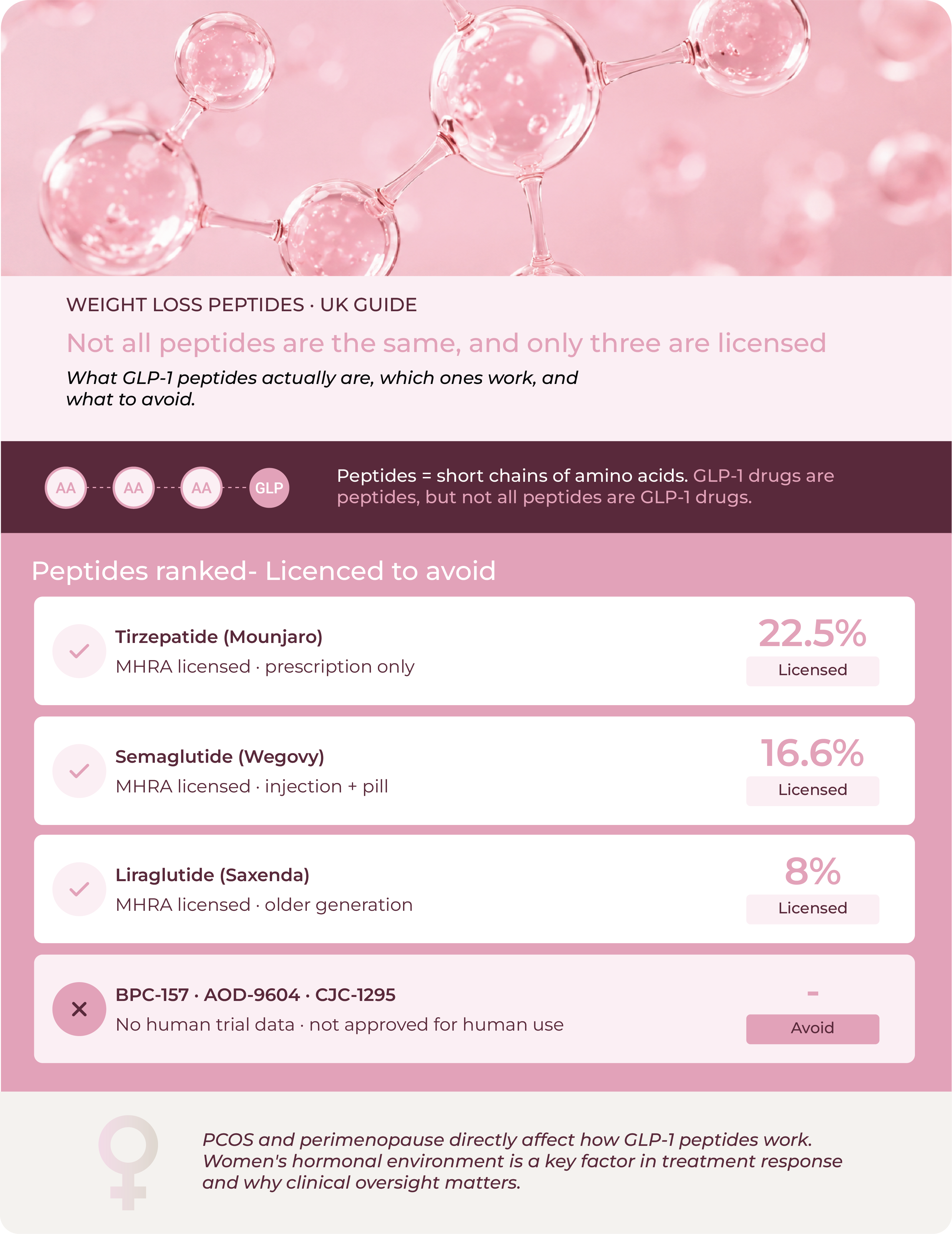
There are only three as of June 2026. All prescription-only. All MHRA-licensed. All with serious clinical trial data behind them, with over 2.5 million people in the UK accessing one of these every month.
Semaglutide (Wegovy): The Popular one
Semaglutide is the active ingredient in Wegovy. It works on GLP-1, meaning it mimics the fullness hormone.
- Usage: Once a week injection
- Average weight loss: 14.9% at 68 weeks (STEP 1, NEJM 2021). 20.7% at 72 weeks at the new 7.2mg dose (STEP UP, Lancet 2025)
- Additional benefit: The only weight loss injection licensed in the UK to also reduce the risk of heart attacks and strokes (NICE, April 2026)
- UK availability: MHRA-licensed, available privately from ~£130/month and NHS via specialist services
- Oral form: Wegovy pill (25mg oral semaglutide) has been approved by the MHRA and is now available privately.
Read more: Wegovy pill vs injection →
Tirzepatide (Mounjaro): The Dual-Hormone Option
Mounjaro works on both GLP-1 and GIP, another gut hormone. Think of it as turning down the volume on hunger and also unplugging the speaker. This additional mechanism is what gives Mounjaro higher average weight loss results
- Usage: One weekly injection.
- Average weight loss: 22.5% at 72 weeks at 15mg (SURMOUNT-1, NEJM 2022)
- Also good for: Type 2 diabetes, PMOS-related insulin resistance, women who’ve plateaued on Wegovy
- UK availability: MHRA-licensed · available privately from ~£149/month · NHS via specialist services and GP prescribing (rolling out 2026–27)
🔗 Source: Jastreboff AM et al. — SURMOUNT-1. NEJM. 2022;387(3):205–216
Read more: Mounjaro vs Wegovy: which is right for you →
Liraglutide (Saxenda): The Longest Track Record
Saxenda was the first GLP-1 medication approved specifically for weight loss. It produces lower average results than Wegovy or Mounjaro, but has over a decade of real-world safety data. It’s also licensed for young people aged 12.
- Usage: Daily injection.
- Average weight loss: ~8% at 56 weeks (SCALE Obesity trial)
- Best for: Women who haven’t responded to semaglutide or tirzepatide, or younger patients
- UK availability: MHRA-licensed, available privately, limited NHS access
Everything else currently being sold as a ‘fat loss peptide’ in the UK is either unlicensed or lacks meaningful human evidence.
A note on collagen peptides: Collagen peptides in your supplements don’t count as ‘peptides for weight loss.’ Collagen peptides support skin elasticity and joint health, and there’s some evidence they help with satiety as a protein source. But they don’t work like GLP-1 medications and have no comparable weight loss data. So, don’t let anyone sell you collagen supplements in the same conversation as Wegovy or Mounjaro.
Common Peptide Side Effects and Who Shouldn’t Take Them
For the three licensed GLP-1 peptides, side effects are well-documented and largely gastrointestinal:
- Nausea - most common, usually in early weeks and after dose increases
- Constipation and diarrhoea
- Vomiting - more common with the oral pill form than injections
- Fatigue in early weeks
Who should not take licensed GLP-1 peptides:
- History of medullary thyroid carcinoma or MEN2 syndrome
- Personal or family history of medullary thyroid cancer
- Pregnant or planning to conceive (stop at least 2 months before trying)
- Severe gastrointestinal disease
For a full breakdown: most common side effects of GLP-1 agonists →
Peptides to trust and the ones to avoid in the UK
We’ve told you everything you need to know about the ones you should trust. There are many you shouldn’t. The table below will help you understand why –
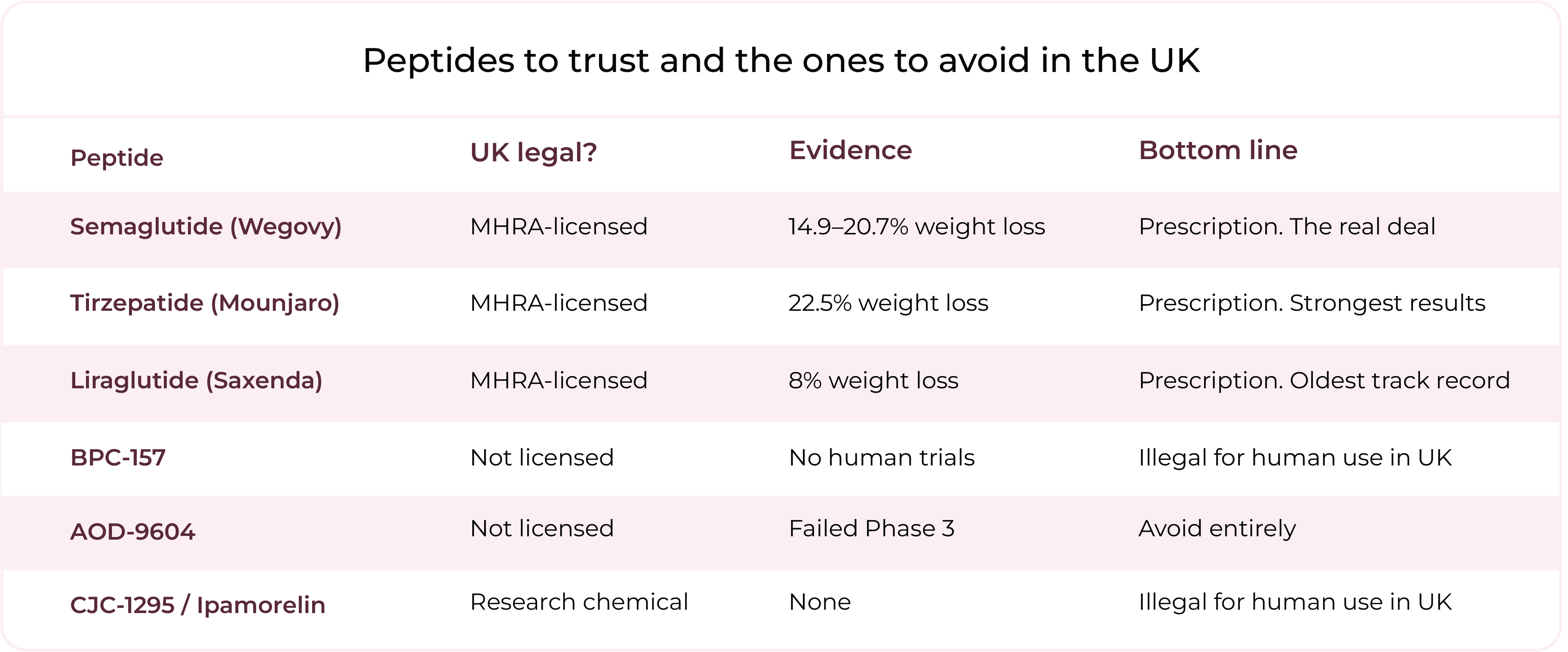
If someone in your gym or on your group chat is recommending peptides that you can buy without a prescription, please read the table above before you order anything. We’re not trying to scare you. We just know that the difference between a clinically-tested prescription medicine and an unregulated research chemical is not always obvious from a website. But the consequences of getting the wrong one can be serious.
From £59 for your first month. Start your transformation journey today →
Frequently Asked Questions
What are peptides for weight loss?
Peptides are prescription medicines that mimic hormones your gut already produces to help regulate appetite. The ones with real evidence in the UK are semaglutide (Wegovy), tirzepatide (Mounjaro), and liraglutide (Saxenda).
Are peptides the same as collagen peptides?
No. Collagen peptides are short fragments of collagen protein used in supplements for skin and joint support. They’re not GLP-1 medications, they don’t suppress appetite, and they have no comparable weight loss data. The word ‘peptide’ describes the molecular structure, not the function.
Are peptides legal in the UK?
Licensed GLP-1 peptide medicines (Wegovy, Mounjaro, Saxenda) are legal prescription-only medicines regulated by the MHRA. Research peptides like BPC-157, CJC-1295, and ipamorelin are classified as research chemicals and are not legal for human use or sale in the UK. Selling them for human consumption is unlawful under the MHRA borderline product rules.
What is the best peptide for weight loss?
Based on current clinical evidence, tirzepatide (Mounjaro) produces the highest average weight loss of 22.5% at 72 weeks. Semaglutide (Wegovy) at 7.2mg is comparable at 20.7%. Both are significantly ahead of liraglutide (Saxenda) at approximately 8%. The best choice depends on your health profile, budget, and individual response.
Do peptides work differently for women?
Yes. Women with PMOS often respond very well because GLP-1 medications also improve insulin sensitivity, addressing one of the root causes of PMOS-related weight gain. Perimenopausal women respond well because GLP-1 medications work on appetite biology independently of oestrogen levels. Many women also notice their experience changes at different points in their cycle.
Can I buy peptides for weight loss without a prescription in the UK?
Not legally if they are GLP-1 medications. Licensed GLP-1 medications require a valid UK prescription from a registered prescriber. Websites selling GLP-1 peptides or semaglutide without requiring a prescription are operating illegally or selling something that isn’t what it claims to be. Always check GPhC registration at pharmacyregulation.org.
Are collagen peptides good for weight loss?
Collagen peptides contribute protein, which supports satiety and muscle preservation during weight loss. There is no evidence that they produce meaningful weight loss on their own. They are not GLP-1 medications and should not be marketed or sold as weight loss treatments.
What peptides are coming to the UK for weight loss?
The Wegovy pill (oral semaglutide 25mg) is now available in the UK. Orforglipron (Foundayo), the first non-peptide GLP-1 receptor agonist, was FDA-approved in April 2026 and is expected in the UK by late 2026 or early 2027. Further out: zenagamtide (GLP-1 + amylin, Phase 3) and CagriSema (semaglutide + cagrilintide, Phase 3) are in development but realistically 3–4 years from UK availability.
Sources & Further Reading
1. MHRA — GLP-1 Medicines for Weight Loss and Diabetes (GOV.UK, updated 2026)
2. Wilding JPH et al. — STEP 1: Semaglutide 2.4mg for Obesity. NEJM. 2021;384(11):989–1002
3. Jastreboff AM et al. — SURMOUNT-1: Tirzepatide for Obesity. NEJM. 2022;387(3):205–216
4. NICE CG189 — Obesity: Identification, Assessment and Management
5. NICE TA875 — Semaglutide for Weight Management
6. NICE TA1026 — Tirzepatide (Mounjaro) for Managing Overweight and Obesity
7. NHS — Obesity Treatment Overview
8. Drucker DJ — GLP-1 Receptor Agonists: Mechanisms of Action (PubMed PMC7839771)
9. The Pharmaceutical Journal — Everything You Need to Know About GLP-1s (February 2026)
10. NICE — Semaglutide for Cardiovascular Risk Reduction (April 2026)
The content on the SheMed blog is provided for general informational and educational purposes only. While SheMed provides professional weight loss services and strives to ensure the information shared is accurate and up to date, we make no representations or guarantees as to its accuracy, completeness, or timeliness. This content should not be taken as personal medical advice or a substitute for consultation with a qualified healthcare provider. Always speak with your doctor or licensed medical professional about your individual health or medical needs before starting any new treatment or programme. Never disregard or delay seeking professional medical advice because of something you have read on this site. SheMed is not responsible for any actions you may take based on the information provided in this blog.
Related Articles